Your Tax Bracket Is the Wrong Test
Most advisors agree on one rule: don’t convert in a high bracket. That rule is wrong.
Your bracket tells you what a conversion costs. It says nothing about whether you get the money back. Two retirees in the same 32% bracket can get opposite answers, because one has a way to recover the tax and the other doesn’t.
Two questions decide it.
Can you pay the tax from outside the IRA? If the bill comes out of the IRA itself, you’re paying tax on the money you’re using to pay tax.
Do you have a plan to recover it? A conversion trades a big bill now for tax-free income later. With no plan to earn that back, you’re paying the IRS early and hoping.
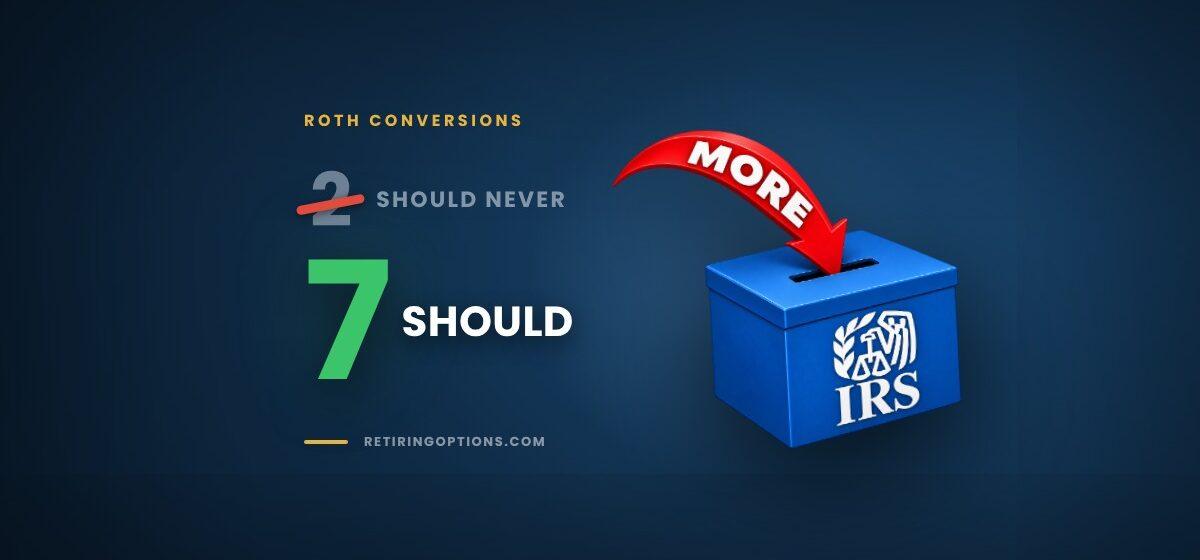
Answer no to either one and you’re one of the two retirees who should never convert. Everyone else is on the list below.
The Nine Retirees
| Retiree type | Usually told | The actual answer |
|---|---|---|
| No outside money for the tax | Don't convert | Correct. Don't. |
| No plan to recover the tax | Varies | Don't, until you have one. |
| Forever high earner | Never convert at your rate | Has the most to gain |
| RMD tax bomb | Keep deferring | Convert early and big |
| Minimalist | You're already low, skip it | Converting can get you lower |
| IRMAA-sensitive | Converting raises premiums | Two years of IRMAA beats thirty |
| Charitable giver | Use QCDs instead | QCDs and conversions solve different problems |
| Spousal protector | Only convert if it helps you | Converting protects your spouse better |
| Legacy planner | An IRA is a great inheritance | IRAs force high taxes on heirs |
The Seven Who Should Convert
1. The forever high earner
You have a high income and intend to keep it, so advisors say never convert. But the low-bracket window you’re waiting for is never going to open. Converting once at a high rate buys decades of income that generates little reportable income, less exposure to Medicare surcharges, and less tax on Social Security.
2. The RMD tax bomb
Required distributions now start at 73 for those born 1951 through 1959, and 75 for anyone born in 1960 or later. Every delay compounds the problem.
A 60-year-old with $4 million growing at 8% faces a first RMD above half a million at 75, landing in the 32% to 35% brackets immediately. The balance grows faster than the withdrawals, so the 37% bracket arrives within a few years and the forced withdrawal passes a million by the mid-80s. Converting early is the only thing that defuses it. The five-bucket RMD approach covers the sequencing.
3. The minimalist
You’re in the 12% or 22% bracket, so a conversion looks like a solution to a problem you don’t have. Two things get missed. Low isn’t the same as lowest. And the jump from 22% to 24% costs two points, with that bracket running to roughly $200,000 single and $400,000 joint. You can convert far more than you think before the marginal cost moves. The 2026 bracket tables show the lines.
4. The IRMAA-sensitive
Yes, converting can raise your Medicare premiums. But IRMAA recalculates every year, so it isn’t permanent. And a large IRA triggers IRMAA anyway once RMDs begin.
The real choice isn’t IRMAA versus no IRMAA. It’s a few years of IRMAA now, or IRMAA for life. One timing note: the surcharge uses a two-year lookback, so income at 63 sets premiums at 65. Do your biggest conversions before 63 if you can. How the tiers work.
5. The charitable giver
QCDs let you give from an IRA tax-free after 70½, which sounds like it replaces conversions. It caps at $111,000 per person for 2026, and a $2.7 million IRA at 75 already produces an RMD near that. It also assumes you want to give away $111,000 every year.
QCDs handle money you give away. Conversions handle money you keep. Most charitable retirees need both.
6. The spousal protector
When one spouse dies, the survivor files single within a year or two. Single brackets are about half as wide, and the IRMAA thresholds compress the same way. Income doesn’t fall by half, though: the smaller Social Security check disappears but the RMDs continue. That’s a permanent tax increase arriving right after a death, and converting while both of you are alive prevents it.
7. The legacy planner
Under the SECURE Act, most children who inherit your IRA have ten years to empty it, taxed on every dollar, usually during their peak earning years. Heirs cannot convert an inherited IRA to a Roth. The option you have doesn’t exist for them. They pay at their rate with no way to recover it.
How to Recover the Tax Hit Faster
Standard advice says a conversion takes a decade to break even, because you’re waiting for tax-free growth to exceed the tax you paid. Converting into a contract that pays a guaranteed annual amount shortens that considerably.
A Hybrid Pension is a fixed indexed annuity with a lifetime income rider. The account stays yours, can grow, and passes to your beneficiaries. The rider pays a guaranteed income for life even if the account reaches zero. Unlike a SPIA or DIA, nothing is surrendered irrevocably, which is what makes a conversion possible at all. More on the structure.
The payout rate isn’t an investment return. It works like Social Security: a payment calculated from your deposit, your age, and how long you wait. Deferring produces a bigger check.
| When income starts | Hebrid Pension payout | Years to recover a 35% tax hit |
|---|---|---|
| Immediately | 6.5% to 9% | About 4 to 5 |
| After 5 years | 10% to 15% | About 2.5 to 3.5 |
| After 10 years | 17% to 23% | About 1.5 to 2 |
Rates vary by age, state, carrier, and the rates in effect when you sign. The rider fee, around 1% a year, comes from the account value, not the income.
Three Things This Math Doesn’t Cover
Part of each payment is your own principal coming back. Cash flow recovers quickly. That isn’t the same as being made whole on net worth.
Money spent on taxes stops compounding. The cost is real and it arrives first. Decades of tax savings can outweigh it, but not immediately.
Converting an annuity inside an IRA may be taxed on more than its cash value. Treasury rules generally use the contract’s fair market value, which can include rider value. That lengthens every break-even figure above. Confirm with your tax professional and the carrier first.
Roth distributions are also tax-free only after the five-year rule is satisfied.
Getting Your Own Numbers
Payout rates move with age, state, carrier, and current rates. Your tax rate depends on where you live and what else you earn.
KCIIS represents more than 50 plans across all 50 states and charges nothing for consultations, because the carrier pays the firm rather than the client.
Frequently Asked Questions
Does my tax bracket decide whether I should convert?
No. The bracket sets the cost. The decision comes down to having outside money for the tax and a plan to recover it.
What's the best age to convert?
The earliest year you can afford the tax. Before 63 avoids affecting Medicare premiums, since IRMAA looks back two years. Before RMDs begin avoids stacking on forced withdrawals.
Can I convert if I'm already taking RMDs?
Yes, but take the full required distribution first. An RMD cannot be converted.
Can I undo a Roth conversion?
No. Recharacterization ended with the 2017 tax law. Once converted, it’s final for that year.
Do Roth IRAs have required minimum distributions?
Not for the original owner. That’s a large part of why conversions reduce lifetime forced income.
Will converting raise the tax on my Social Security?
In the conversion year, probably. In later years, qualified Roth distributions don’t count toward that calculation.
Can an IRA annuity be converted to a Roth?
A SPIA or DIA generally cannot, because it’s irrevocable. A Hybrid Pension written to allow partial conversions can. Terms vary and the taxable amount may be based on fair market value, so confirm both before buying.


Contact Us Get in Touch
Have a question or feedback?
Fill out the form below, and we’ll respond promptly!

By providing your name and contact information, you are consenting to receive calls, text messages, and/or emails from a licensed insurance agent about Medicare Plans at the number provided. You agree that such calls and/or text messages may use an auto-dialer or robocall, even if you are on a government do-not-call registry. This agreement is not a condition of enrollment.
Not connected with or endorsed by the United States government or the federal Medicare program. This is a solicitation of insurance, and your response may generate communication from a licensed producer/agent.