
Open any major financial publication and you will run into the exact same warning: You need at least $1.5 million saved to retire safely today.
Over the last 21 years, we at KCIIS have helped thousands of clients retire comfortably. And we can tell you that not only is that retirement savings number misleading. But the math behind it is structurally broken.
According to recent retirement income studies, the new $1.5 million savings amount is a $200,000 jump from just a year ago. And it is because the financial media continually pushes variations of the 3% or 4% rule. Under that framework, at a 4% withdrawal rate, Wall Street says you need $2.1 million in liquid savings just to spend $85,000 a year. No wonder people feel like they’ll never be able to retire!
But here is the problem with this advice: the underlying math uses assumptions that contradict each other, and uses Social Security income amounts that are flat out misleading. And believing these headlines forces successful savers to work years, sometimes even decades, longer than they actually need to. Correcting these hidden errors reveals how you can safely retire with a fraction of the conventional $1.5 million saved. And no, it’s not living on beans and rice.
The Hidden Math Error in Mainstream Retirement Studies
The data in mainstream retirement articles sounds reasonable on the surface. Projections follow a standard baseline: they take your $1,500,000 portfolio, apply a conservative 3% withdrawal rate, and tell you that gets you $45,000 a year. Then they add the average Social Security benefit of about $2,000 a month ($24,000 a year) to arrive at a total of $69,000 a year for the next 30 to 35 years.
If you stop right there, the math looks correct. But two completely different retirement timelines are hiding inside that single calculation, and they cannot both be true at the same time. Let us show you.
The Timeline Conflict
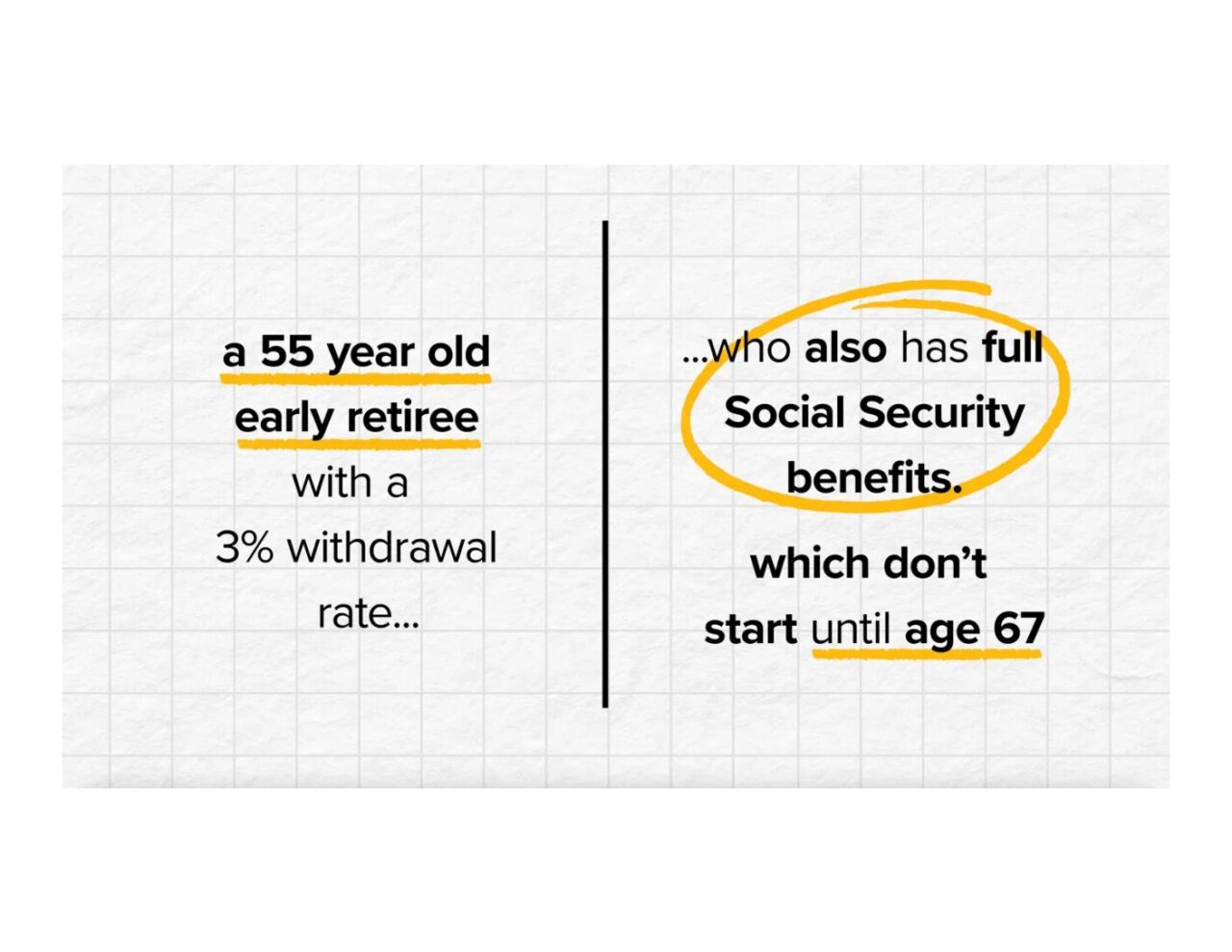
An ultra-conservative 3% withdrawal rate is a metric designed to protect a 40-year retirement horizon. That long of a runway only makes sense if you are retiring early, say at age 55. Yet in the same breath, the calculation layers in Full Social Security benefits, which by law you cannot collect until age 67.
So which is it? Are you an early retiree leaving at 55 with 40 years ahead of you, or a traditional retiree leaving at 67 with a 25-year horizon? Quoting someone the lifestyle budget of a 25-year retirement while enforcing a withdrawal rate built for a 40-year plan is flawed math. It mixes two entirely different demographic profiles to create an artificially high financial barrier to retirement.
The 3% Safe Withdrawal Rate Has No Research Behind It
A rigid 3% withdrawal rate is significantly lower than what empirical retirement research supports. A traditional, fixed 40-year retirement safely supports a baseline withdrawal rate of about 4.1%. Even highly conservative Monte Carlo models routinely clear 3.6% annual withdrawals. And a dynamic system with systematic guardrails allows savers to safely pull up to 5%.
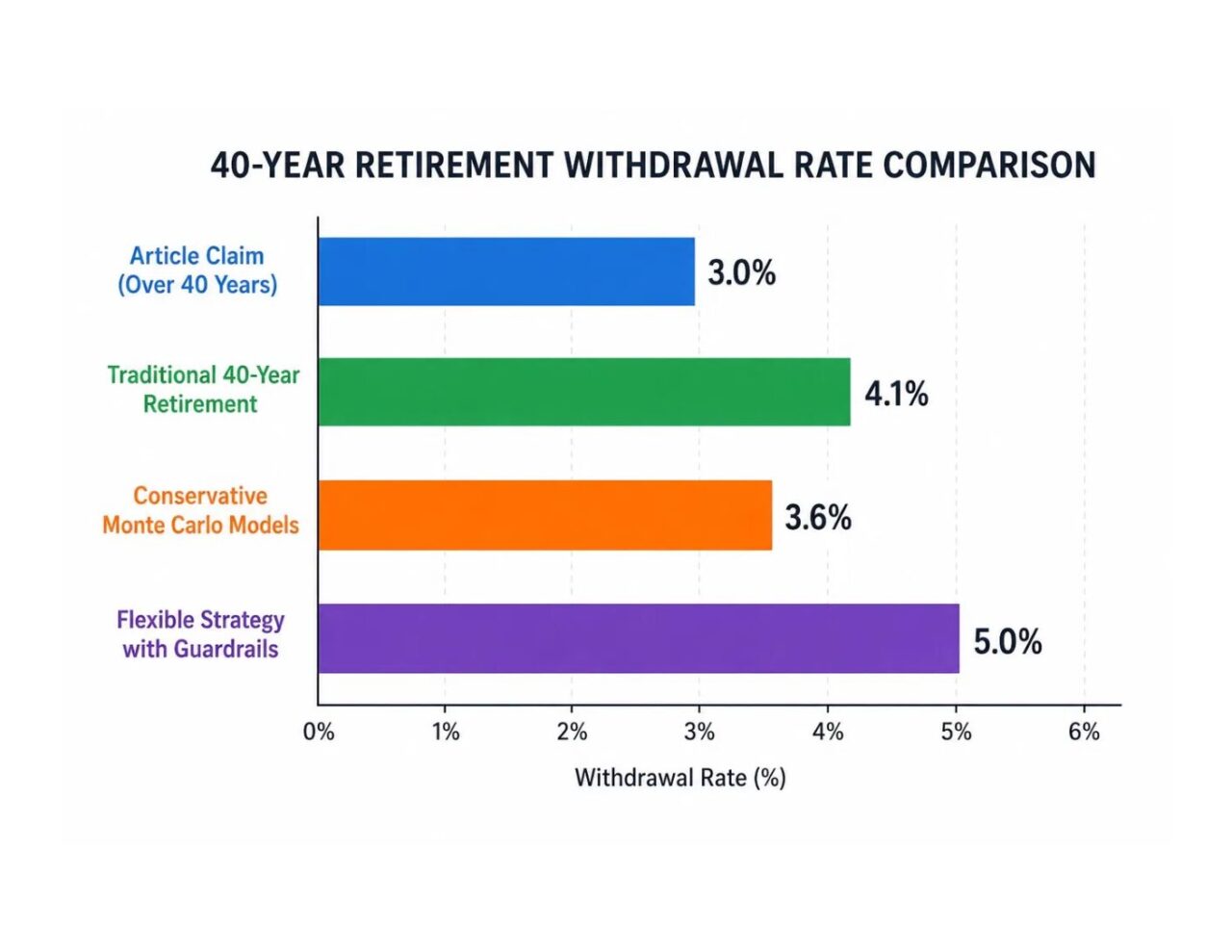
By combining a withdrawal rate lower than the most conservative research supports on top of an artificially low Social Security assumption, mainstream studies present a worst-case scenario as the baseline for your retirement situation.
The “Average” Social Security Trap
Mainstream studies also assume a household will receive the national average Social Security benefit of roughly $2,000 a month ($24,000 a year). While that is accurate for the median American worker, it is completely inaccurate for a household that has saved $1.5 million.
According to Federal Reserve net worth data, a $1.5 million net worth places a household in the top 10% of the entire country. But that includes the value of your homes, vehicles, and businesses. If someone has $1.5 million in just liquid savings, that places them squarely in the top 2% – 4% of households. If this is you, you are not an average household.
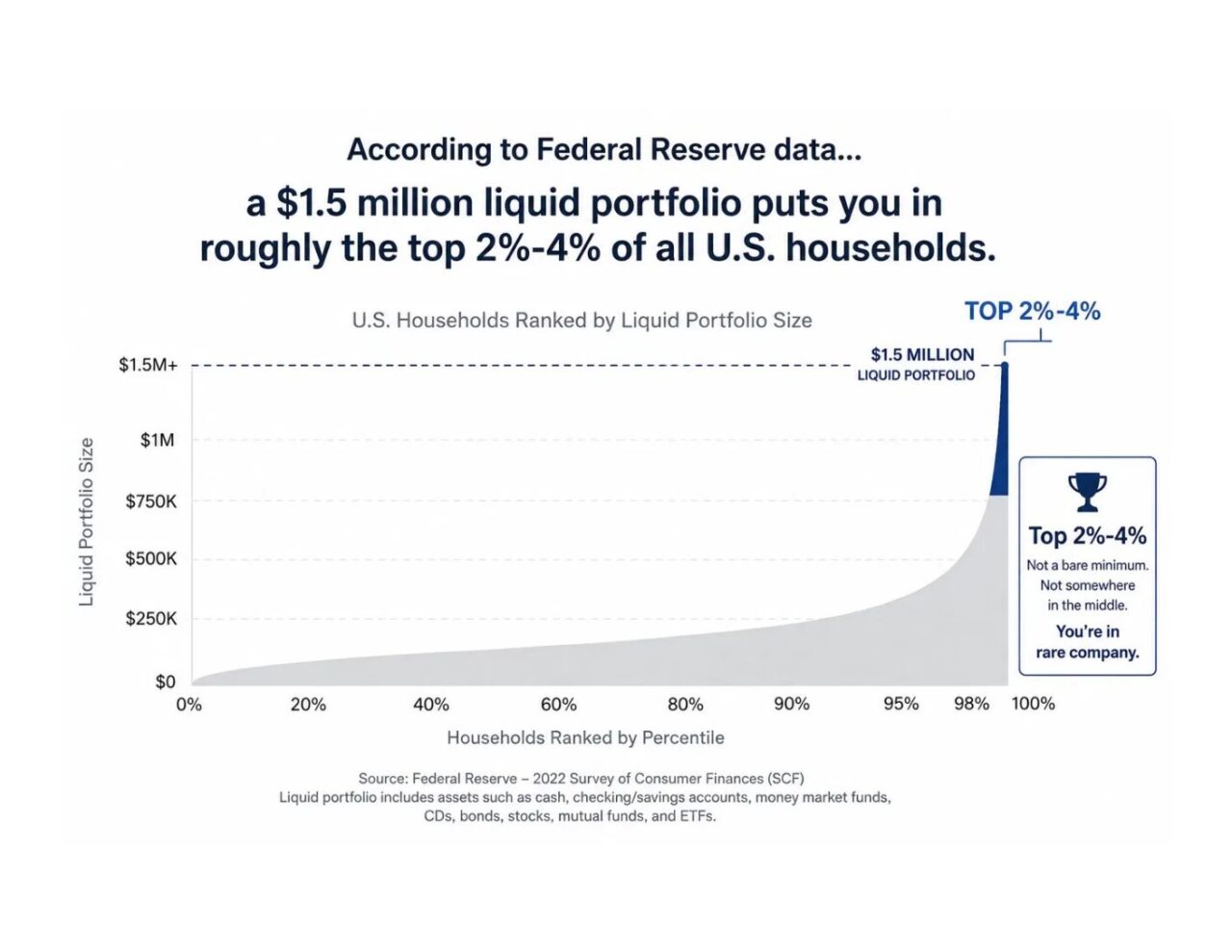
Savers who amass this level of wealth by their mid-50s to early 60s typically had peak career earnings of $200,000 to $500,000 a year.
To receive the “average” $2,000 monthly check, a worker’s lifetime indexed earnings only need to have averaged about $45,000 to $55,000 a year. Mainstream articles are effectively taking a household that earned multiple six-figures for decades and evaluating them using the Social Security income of someone who made $50,000.
The Real Dual-Earner Math
Let’s run a conservative dual-earner household at this wealth level. Assume a career earnings baseline of $125,000 split between spouses, $75,000 for one and $50,000 for the other. Here is their Social Security at the Full Retirement Age of 67.
- Higher Earner ($75k/year): Approximately $2,700 per month ($32,400/year).
- Secondary Earner ($50k/year): Approximately $2,000 per month ($24,000/year).
- Total Social Security Income: Approximately $4,700 per month ($56,400/year).
Now recall that the original study claims a household with $1.5m saved must live on $69,000 a year from a combination of Social Security and a 3% annual safe withdrawal. But correcting the Social Security income raises their guaranteed income projection by over $32,000 every single year. Over a 30-year retirement, that single correction uncovers nearly $1 million of guaranteed, inflation-adjusted income the mainstream financial articles completely missed.
Retirement Is Two Distinct Problems, Not One
And here is what almost everyone is missing in their retirement projections. You are treating your retirement horizon as one long, uninterrupted 30-to-40-year timeline. In reality, retirement happens in phases. And each phase requires a different approach.
For example, take a household retiring at age 55 with $1.5 million and a target lifestyle of $100,000 per year.
Phase 1: The Bridge Phase (Ages 55 to 67)
This covers the 12-year window between the day you leave your career and the day your Full Retirement Age Social Security activates. During these years, your investments are your sole source of retirement income.
The Strategy: Allocate roughly $900,000 into a Bridge Bucket. Its job is absolute predictability over a fixed 12-year window, so it is built from 2 to 4 years of cash reserves up front, supplemented by short-term CDs, fixed income, and minimal equity. The target yield is a stable 4% to 6% annually, insulated from market corrections and crashes.
Phase 2: The Longevity Phase (Age 67 and Beyond)
This phase begins the moment Social Security turns on. Your portfolio no longer has to fund your lifestyle by itself.
The Strategy: The remaining $600,000 goes into a Longevity Bucket at age 55 with a single goal: compound for 12 years without touching it. Because it has time on its side, it stays heavily weighted in broad-market equities and can ride out short-term drops. The target growth rate is an equity-driven 6% to 8% annually.
The Hand-off
When you turn 67, you have drawn down your Bridge Bucket, but your $600,000 Longevity Bucket has compounded untouched for 12 years, likely growing to somewhere between $900,000 and $1.2 million, assuming it is invested in a conservative and diverse basket of stocks, bonds, and commodities. At 67, Social Security turns on, providing roughly $57,000 of guaranteed annual income.
To maintain your $100,000 lifestyle, your portfolio now only needs to fill a $43,000 gap. At a conservative 4% withdrawal rate, your compounded $1 million longevity portfolio yields $40,000. The plan is secure, fully funded, and mathematically insulated from running out of capital.
So yes, $1.5 million can absolutely provide $100,000 of income per year. But honestly ask yourself: Is $100,000 actually the lifestyle you built?
The Silent Pay Cut Built Into Conventional Planning
Here is the reality. A household that accumulated $1.5 million by their mid-50s was typically earning $200,000 to $400,000 a year in their peak earning years. After aggressive saving and paying taxes, their lifestyle while working was likely around $150,000 a year. Then when they retire, they’re taking a permanent 33% pay cut to $100,000 a year. The truth is, your working salary builds your lifestyle. And almost everyone wants to enjoy life, travel, and spend the same or more when they retire; not less.
And taxes make the picture worse. A $100,000 withdrawal from a traditional IRA or 401(k) is taxed as ordinary income, and after federal taxes, state taxes, and the taxable portion of Social Security, real take-home pay shrinks to roughly $80,000 to $85,000. To actually have net income of $150,000 using a 4% safe withdrawal, you would need to withdraw closer to $180,000 gross. And if you withdraw $180,000 every single year, you actually need around $3.1 million saved to sustain your withdrawals.
But here is the good news:
The issue is not that you didn’t save enough. It is the outdated retirement rules that make retiring feel impossible. No wonder everyone thinks they need millions to retire! But there’s something they’re not telling you.
Changing the Engine: The Hybrid Pension Framework
If you want to enjoy the same lifestyle you build in your working years without accumulating $3 million or taking aggressive market risk, you have to look beyond outdated rules like the 4% rule. Instead, use a strategy that provides contractually guaranteed income for life. This is achieved through a retirement vehicle known as a Hybrid Pension.
A Hybrid Pension is a newer type of annuity, established through a highly rated insurance company, that works the same way a traditional employer pension or Social Security does. The difference is that you set it up for yourself, instead of your employer or the federal government. You can allocate a portion of your retirement savings into the Hybrid Pension, you will receive a contractually guaranteed lifetime payout that cannot be affected by the stock market. Just like a traditional pension or Social Security.
Clearing Up Misconceptions
There are 5 main types of annuities. Some lock up your money for life. Others have excessively high fees. A Hybrid Pension is neither of those.
A Hybrid Pension is NOT an Immediate Income Annuity (SPIA). Standard immediate annuities permanently surrender your principal. A Hybrid Pension preserves both a guaranteed lifetime paycheck and full contractual access to your underlying cash value. You do not ever forfeit your money to the insurance company.
A Hybrid Pension is NOT a Variable Annuity. Variable annuities expose your principal to market losses while stacking fees that often average 3% to 4% annually. A true Hybrid Pension uses a fixed indexed annuity framework with total principal protection, keeping internal fees exceptionally low, often under 1% and sometimes even zero.
A Hybrid Pension is NOT a Life Insurance Pitch. This has nothing to do with infinite banking, whole life insurance, or universal life insurance. It is simply a pension that you can make for yourself without having to sacrifice your cash value.
The Contractual Payout Multiplier
Because Hybrid Pensions payouts are structured about mortality tables, they can offer guaranteed lifetime payout rates ranging from 10% to 20%, depending on your age and deferral timeline. These are not projections and they are not market-dependent. They are contractually written into your Hybrid Pension policy from day one.
Here is how the required portfolio size drops when you shift from the traditional 4% rule to a Hybrid Pension structure:
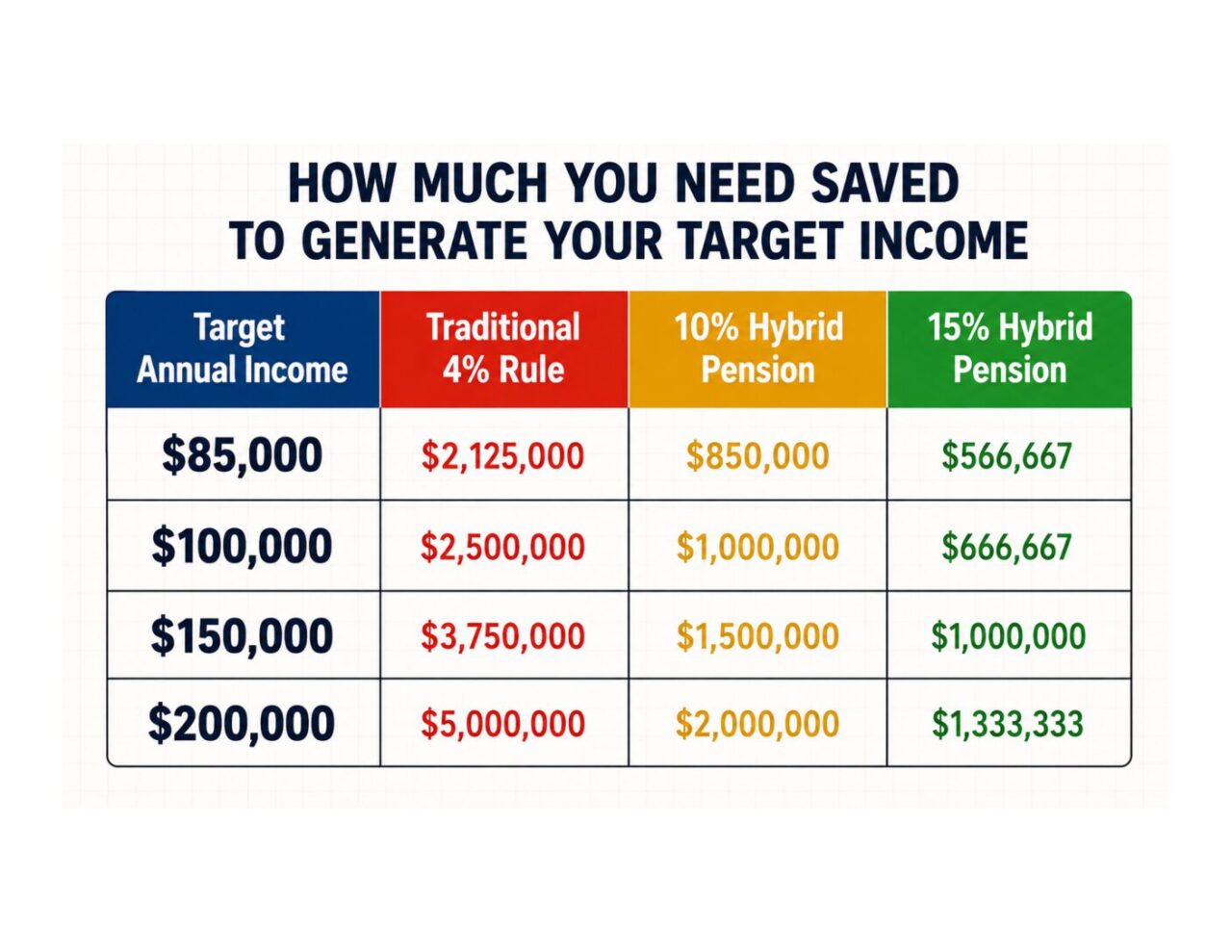
Look at the $150,000 tier. The 4% rule requires you to have a $3.75 million portfolio. An optimized 15% payout Hybrid Pension secures that exact same lifetime income with only $1 million saved. You can live the same lifestyle, guaranteed for life, with less than one-third of the savings.
And this income doesn’t even factor in Social Security. Because Social Security adds on top, it easily covers what you owe in taxes each year. Now, whatever is left over becomes money you can travel with, gift to your kids, or leave as a legacy. But you don’t need it to fund your lifestyle.
Why Has the Financial Industry Kept This Quiet?
If these options have existed for the past few decades, why do major firms keep pushing the narrative that you need millions saved? The answer is in the incentives.
Most financial advisors are paid through Assets Under Management, or AUM. This is a recurring fee, typically 1% to 1.5% every year, on the money they manage for you. On a $1.5 million portfolio, a 1.25% fee is $18,750 a year, or roughly $468,750 over a 25-year retirement. Those fees are predictable, passive, and recurring for the advisor. Which is exactly what makes the advisor’s book of business valuable enough to live on and eventually sell. The moment a client moves their money into a Hybrid Pension, the financial advisor can no longer charge AUM and the recurring fee is lost.
This is not a conspiracy. It is the incentive structure. But it explains why a strategy with 10% to 20% guaranteed payouts stays shelved across the retirement industry.
To be transparent about our incentives at KCIIS: We are not paid by the size of your portfolio or Hybrid Pension. We are paid by the insurance company on a one-time basis when we help you set up a plan that fits your situation and goals. This means that we have no incentive to recommend keeping your money in one place.
Upgrading the Blueprint: Staging & Laddering
Lastly, you must be wondering how it is possible to reach a 10% to 20% payout.
Securing the highest payout on your Hybrid Pension requires a customized Staging and Laddering plan. At KCIIS, we build these frameworks using two core proprietary strategies: Staging and Laddering, and Laddering OUT & Laddering IN.
If you would like to see exactly how a Hybrid Pension fits into your retirement plan, we’re here to help. We work with over 50 plans and assist in all 50 states. And most importantly, every strategy we recommend is tailored to fit your lifestyle, risk tolerance, and long-term goals.
Let’s schedule a time to walk through your options.
We’ll show you how the numbers work side-by-side with your current plan. Let us help you retire not just comfortably, but confidently, with a plan that truly pays off.
By providing your name and contact information, you are consenting to receive calls, text messages, and/or emails from a licensed insurance agent about Medicare Plans at the number provided. You agree that such calls and/or text messages may use an auto-dialer or robocall, even if you are on a government do-not-call registry. This agreement is not a condition of enrollment.
Not connected with or endorsed by the United States government or the federal Medicare program. This is a solicitation of insurance, and your response may generate communication from a licensed producer/agent.



Contact Us Get in Touch
Have a question or feedback?
Fill out the form below, and we’ll respond promptly!