
YouTube Video Coming Soon!
Why Vanguard’s Own Report Shocked the Retirement World
Vanguard, one of the most trusted names in investing, just released a 51-page report on retirement income strategies.
Its recommendation to retirees caught almost everyone off guard: buy an annuity.
Within days, advisors across YouTube were explaining why that was terrible advice.
“Your money gets locked up for life.”
“There’s no death benefit.”
“It doesn’t keep up with inflation.”
And technically, none of that is wrong. But even the most credible advisors missed something incredibly important. And a firm the size of Vanguard doesn’t spend that kind of research budget by for no reason.
So what did they actually find?
Why Vanguard Recommended Annuities to Retirees
In 21 years, we’ve never seen advisors push back so hard on a Vanguard report. And to understand why, you have to see what’s actually in it.
On page 8, Vanguard lays out what would happen if a retiree used different safe withdrawal rates. The data shows that if you withdraw 4% a year from your investments, your money should last for a full 30-year retirement.
But if you withdraw any more than 4%, you are likely to run out of money in less than 30 years.
This is the trap neither Vanguard nor advisors addressed.
If your retirement is funded by a 4% withdrawal, you will need millions of dollars to retire comfortably.
For example, to safely withdraw $80,000 a year, you would need $2 million saved.
That leaves two options: keep working until you have millions saved, or withdraw more than 4% per year and risk outliving your money. And remember, Vanguard’s own data shows what happens when you withdraw any more than 4%.
On page 10 of the report, they run a real scenario of someone starting with $1 million, withdrawing 6% a year. That retiree ran out of money in about 20 years.
So what was Vanguard’s solution? This is the part that shocked advisors. Vanguard’s own solution is to cover essential expenses with guaranteed income, specifically naming Social Security, pensions, and annuities.
Most advisors are either against annuities entirely, or steer clients toward investments first. Very few recommend an annuity as the actual foundation of a retirement plan the way Vanguard just did.
The Type of Annuity Vanguard & Advisors Missed
Financial advisors all across YouTube raised three main objections to buying an annuity:
They were:
- The money is locked up, with no way to get it back.
- If you pass away early, nothing goes to your beneficiaries.
- The payout doesn’t adjust for inflation.
Here’s the problem.
All three of these objections to annuities describe one specific type of annuity: traditional annuities. These are SPIAs (Single Premium Immediate Annuities) and DIAs (Deferred Income Annuities), which are only two of the 5 types of annuities.
It’s a bit like listing everything wrong with a rotary phone.
- No caller ID.
- Can’t text.
- Stuck to the wall.
These objections are all true… and exactly why the smartphone was invented.
So what type of annuity did they miss? In the early 2000s, a new type of annuity was designed to solve the most common objections of traditional annuities. It combines features of different deferred annuities with a lifetime income rider. That’s what we call a Hybrid Pension.
A word of caution: some Hybrid Pensions are built on a variable annuity, which doesn’t protect your principal from market loss and often carries fees of 3% or more a year. That structure tries to do a bit of everything and does none of it particularly well. On the other hand, a fixed Hybrid Pension, by contrast, offers full principal protection with a fee closer to 1%. The 1% fee is what ensures that you have contractually guaranteed income for life, no matter how long you live.
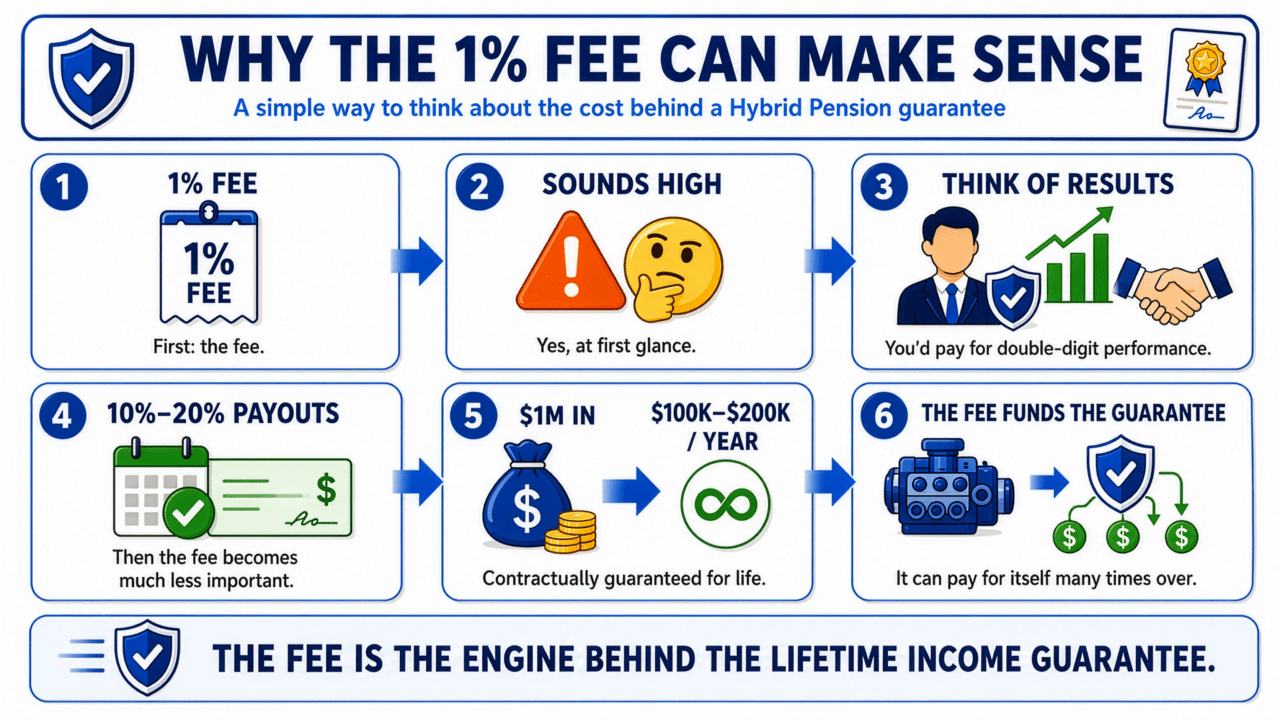
On a hybrid pension, the income works as a rider which is contractually guaranteed for life. But unlike a SPIA or DIA, you control when it starts. You can take income immediately, or defer it years into the future. You can use the same logic as delaying Social Security: the longer you wait, the higher the eventual payout.
Why Nobody Talks About Hybrid Pensions
If this type of annuity has existed for decades, why is it rarely brought up by financial professionals? For example, popular finance YouTuber, Kevin Lum, made a video on the Vanguard report that never mentioned hybrid pensions or income riders. Only briefly touching on an inflation rider.
Part of it is awareness. Most people only know about the older, irrevocable types of annuities. Because of that, financial advisors only recommend buying small annuities or to avoid them entirely.
That means the bulk of their clients’ money stays in the market. Which happens to be exactly what most advisors benefit from. Advisors can’t charge an ongoing management fee on a guaranteed income annuity the way they can on a managed portfolio. A Hybrid Pension’s commission is paid once, directly by the insurance carrier, never out of your cash value or your income. A managed account’s fee gets paid every year, which is often for 30 years or more.
How Much You Actually Need Saved to Retire
Imagine two retirees who each want $100,000 a year in retirement.
One uses the 4% rule and needs $2.5 million saved.
The other uses a Hybrid Pension with a 15% lifetime payout rate and needs $666,000.
That is roughly four times less money for the exact same income. And remember, this is a lifetime income payout, not a return on investment. The income does NOT depend on any cash growth.
| Desired Annual Income | Needed at 4% Rule | Needed at 10-15% Rule |
|---|---|---|
| $100,000/year | $2.5 million | $666,000-$1 million |
| $200,000/year | $5 million | $1.3 million-$2 million |
| $300,000/year | $7.5 million | $2 million-$3 million |
| $500,000/year | $12.5 million | $3.3 million-$5 million |
| $1,000,000/year | $25 million | $6.6 million-$10 million |
For the full breakdown of how this “10-15% Rule” math works, see our companion article on the guaranteed income formula. Many retirees approaching this decision have already saved enough. They just haven’t seen the math laid out this way.
Can the Market Beat a Hybrid Pension’s Payout?
The most common objection we hear is, “aren’t I missing out on market growth?”
Let’s compare the math. We will use payout rates from one of the top companies we work with as of the publishing of this article. Remember, rates may change over time.
Say you’re 55 years old with $1 million. If you defer starting income 5 years, you would receive a payout of 10.62% of your original deposit. That means you will receive $106,200 a year, guaranteed for life.
To generate that same income from the market using the 4% rule, you’d need $2.65 million. Your $1 million would need to nearly triple in 5 years just to break even.
But what if you don’t need the income for 10 years? Deferred 10 years, your income payout would be 17.11%. That’s $171,100 a year. Matching that income through the 4% rule would require $4.28 million, more than quadrupling your original $1 million in 10 years.
| Deferral | Illustrative Payout | Guaranteed Income | Market Equivalent Needed (4% Rule) |
|---|---|---|---|
| 5 years | 10.62% | $106,200/year | $2.65 million |
| 10 years | 17.11% | $171,100/year | $4.28 million |
Even if your portfolio somehow doubled in 5 years, at the 4% rule that only produces $80,000. Still short of the guaranteed $106,200. And even matching the Hybrid Pension’s payout through market growth alone would only tie it, not beat it, while carrying all the market risk the guaranteed structure avoids entirely.
The Real Problem With Vanguard’s Report
The report’s actual weak point isn’t the annuity recommendation. It’s the philosophy underneath it. Vanguard tells you that you need to cut back, simplify, and spend less during market downturns. That instinct comes from the intrinsic frugality of the 4% rule. Even the more flexible Guyton-Klinger guardrails approach only allows a ceiling around 5.7% as a “safe” withdrawal rate.
Compare that to retirees who receive a full pension from work.
What do they do when the market is down? They live the same exact lifestyle. That’s because their income is guaranteed to show up every month regardless of the market conditions. That is the real difference.
The Annuity Strategy That Beats Inflation
Vanguard’s report acknowledges that the annuities they recommend can’t keep up with inflation. Remember, Vanguard recommended traditional annuities with single-digit payouts of 6% to 8%. But if you know how to strategize your annuity, you can easily have a 10% to 20% payout for life. And when you have the right strategy, outpacing inflation stops being a concern.
That is why we created our strategy “Laddering OUT and Laddering IN.”
Here is how it works:
The first ladder OUT, a larger initial deposit, is sized to cover both essentials and a fuller lifestyle for the first 10 to 20 years of retirement.
Then, you ladder IN. You use funds that would have otherwise sat in CDs or bonds. Those become smaller Hybrid Pensions added later, each deferred 10+ years, with payouts climbing into the 20% to 30% range.
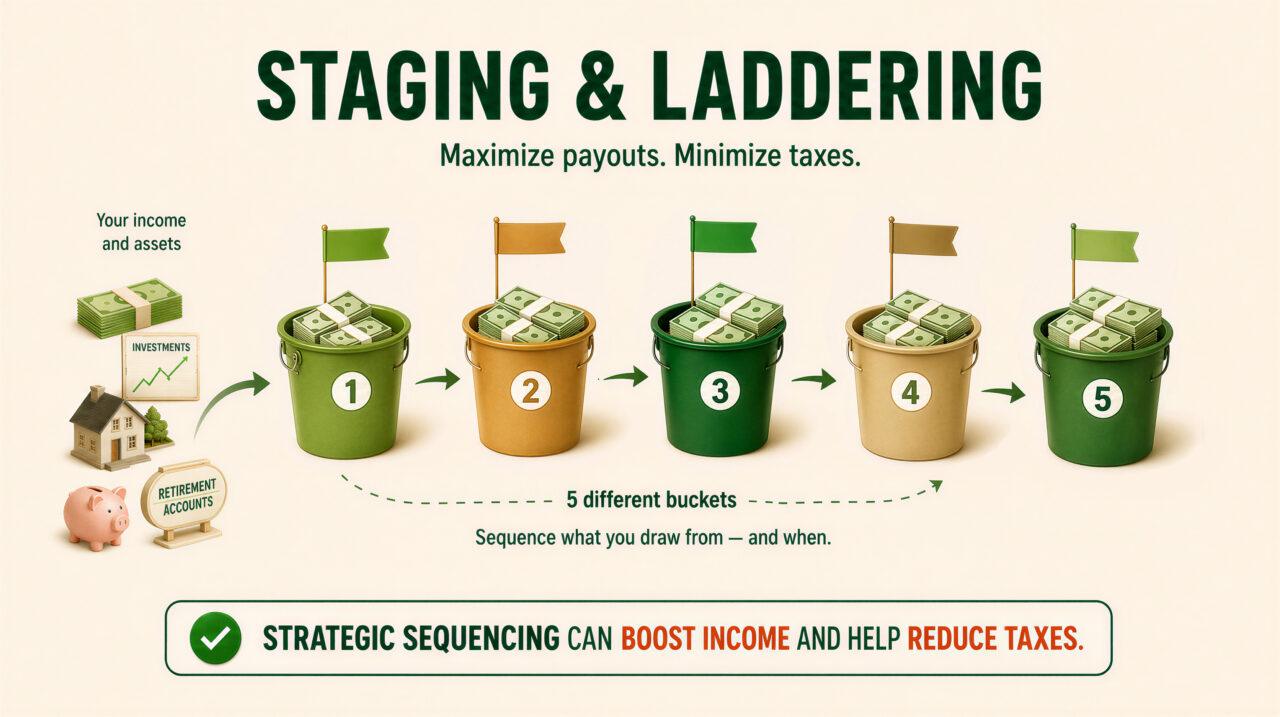
Think of it like an annual raise. A flat pension or hybrid pension never adjusts for cost of living. Laddering builds in your own raises. Every few years, a new, supplemental guaranteed income stream turns on, each one paying more than the last because of the extra deferral.
And remember, you can decide when each ladder activates. This full framework, Staging & Laddering paired with Laddering OUT and Laddering IN, is what lets a retiree minimize taxes while maximizing guaranteed income. No need to predict the future to do it.
Frequently Asked Questions
Did Vanguard really recommend annuities in a recent report?
Yes. Vanguard’s retirement income report recommends covering essential expenses with guaranteed income sources, explicitly including Social Security, pensions, and annuities, alongside market-based investments.
Why do financial advisors push back against annuities if Vanguard recommends them?
Most public criticism has focused on traditional SPIA and DIA annuities, which do lock up principal permanently with often no death benefit or inflation adjustment. That criticism doesn’t apply the same way to a fixed Hybrid Pension, which offers principal control, a death benefit, and flexible timing on when income begins.
What's the difference between a SPIA/DIA and a Hybrid Pension?
A SPIA or DIA requires committing to a fixed income start date upfront and permanently gives up the principal. A Hybrid Pension lets you choose when income begins, keeps you in control of your cash value, and passes any remaining balance to beneficiaries.
Can market investing beat a Hybrid Pension's guaranteed payout?
It’s possible for an investment to beat a hybrid pension’s guaranteed payout, but it requires outsized investment returns in a short window of time. In the example above, you would need to nearly triple a portfolio in 5 years just to match the guaranteed payout of a hybrid pension funded with your starting balance.
See What Vanguard’s Recommendation Could Mean for You
If you want to see how a hybrid pension guaranteed income strategy compares to the 4% rule for your specific numbers, we’d be happy to walk through the math with you.
We represent over 50 plans across all 50 states, and because we’re paid directly by the insurance carriers, the consultation costs you nothing.
Schedule a free, no-pressure consultation with our licensed advisory team at KCIIS today.


Contact Us Get in Touch
Have a question or feedback?
Fill out the form below, and we’ll respond promptly!
By providing your name and contact information, you are consenting to receive calls, text messages, and/or emails from a licensed insurance agent about Medicare Plans at the number provided. You agree that such calls and/or text messages may use an auto-dialer or robocall, even if you are on a government do-not-call registry. This agreement is not a condition of enrollment.
Not connected with or endorsed by the United States government or the federal Medicare program. This is a solicitation of insurance, and your response may generate communication from a licensed producer/agent.