
Why Would a Wealthy Retiree Buy an Annuity?
Most of the financial world says annuities are a bad deal. That they’re for people who don’t know how to invest. So why do so many wealthy retirees own them anyway?
For decades, a specific type of annuity has helped wealthy investors leverage their money in retirement, generating more income than the market alone could produce. All while lowering risk and continuing to aggressively grow their investments.
Let’s walk through how that is possible, and the four main reasons why the wealthy buy annuities. You will see how you can apply this framework to your own retirement, regardless of how much you have saved.
Reason 1: Leverage
Wealthy investors are good at one thing above all else: getting the biggest bang for their buck. The highest payout from the smallest principal possible. That means they would never buy an annuity that only offered a 6% or 8% payout. Most of the annuities marketed today get avoided entirely by sophisticated buyers.
SPIAs (Single Premium Immediate Annuities) and DIAs (Deferred Income Annuities) annuitize your money. You hand over the principal permanently. And those are only two of the five types of annuities. Variable annuities carry fees of 3% or more a year. Neither fits how the wealthy think about leverage.
The one they do use is called a Hybrid Pension, an annuity structured to pay 10% to 20% income, sometimes higher, in a way market-based strategies simply can’t sustain. That double-digit payout is the draw. Not a 6-7% payout, which is what most people encounter when they research annuities online. That’s not the version wealthy buyers use. It’s not the version we’d recommend either.

How the payout scales with deferral (illustrative, one carrier example; actual rates depend on age and carrier):
| Deferral Period | Illustrative Payout |
|---|---|
| 1-3 years | ~8% |
| 3-5 years | ~10% |
| 5+ years | 10%-20% |
| 10 years | 17%-23% |
This is a payout rate, not a return on investment. Compare it to the market. Could your money double in 5 years? Most likely not. Wait 5 years with a Hybrid Pension instead, and the payout can jump from around 6.5% to 10%. More than double the traditional 4% withdrawal rate.
Put $1 million in, and a 10% payout produces $100,000 a year for life. To generate that same $100,000 through the 4% rule, you’d need $2.5 million. Your $1 million would have to grow to $2.5 million in just 5 years to match it.
Wait 10 years, and the payout can reach 17% to 23%. We’ll use 20% as an example. That’s $200,000 a year on the same $1 million. Matching that through the 4% rule requires $5 million. Your original $1 million would need to grow fivefold in a decade.
| Deferral | Illustrative Payout | Income on $1M | Needed at 4% Rule to Match |
|---|---|---|---|
| 5 years | ~10% | $100,000/year | $2.5 million |
| 10 years | ~20% | $200,000/year | $5 million |
Doubling in 10 years is plausible. Tripling, if you pick the right stock, maybe. Five times, guaranteed? No. That’s the leverage only a Hybrid Pension can provide, built using money the buyer wasn’t planning to touch for 5, 10, or more years anyway. The cash value keeps growing throughout that deferral period, and while income is being taken.
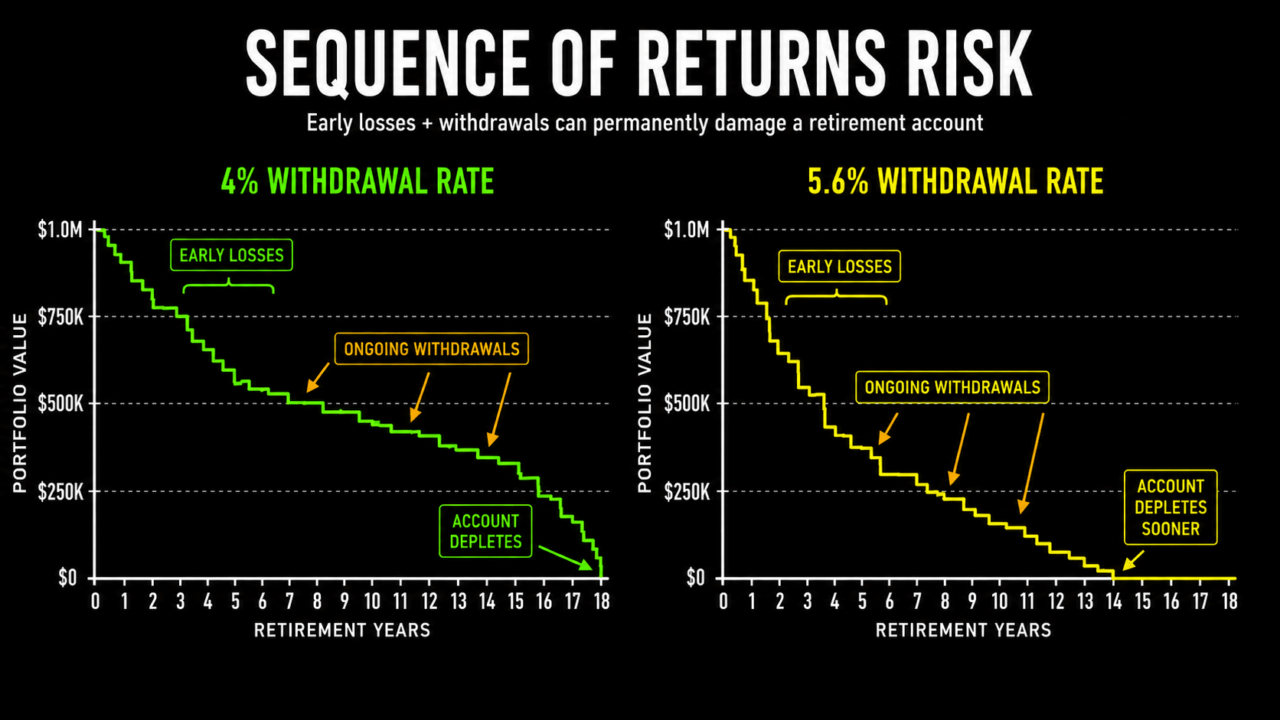
Why this beats the alternative. Rather than locking most of their money into stocks and living off a 4% withdrawal, wealthy buyers use a portion to leverage a payout their investments alone couldn’t produce. Income that’s guaranteed without sequence-of-returns risk, the risk that grows the more income you withdraw, especially if the market turns early in retirement. It’s why even the more flexible guardrail strategy caps withdrawals at 4% to 5.6%
There’s a second layer of leverage too. With guaranteed income covering their base, wealthy buyers can afford to be more aggressive with the rest of their portfolio. Buying and holding without constantly monitoring the market. Less stress. More actual retirement.
Liquidity matters as much as the payout. A DIA locks in your income start date at purchase, with no way to change it later. A Hybrid Pension doesn’t. Start immediately, defer a few years, or never start it at all, the same logic as choosing when to claim Social Security. Change your mind, and you can still cash out. Pass away, and the remaining balance goes to your beneficiaries.
On fees: Hybrid Pensions carry no management fee, since there’s no portfolio to manage. The only cost is a rider fee to guarantee the income, typically around 1%. That 1% is what ensures the income is contractually guaranteed for life, no matter how long you live, not a hoped-for return like a management fee buys elsewhere.



One caution: some Hybrid Pensions carry no fee at all. Those are usually the “hypothetical” version, where the income looks good on paper but isn’t contractually guaranteed. The version described here is.
Rates shift over time. Current numbers are worth confirming directly rather than assuming they match what’s shown here.
Reason 2: Leveraging Long-Term Care
The second reason surprises most people. It’s how the wealthy self-insure against the one expense that can drain even a multimillion-dollar fortune.
Most people hear “long-term care” and assume it won’t happen to them, or that they already have more than enough to cover it if it does. What gets missed isn’t whether they can afford it. It’s how to leverage assets to self-insure as efficiently as possible.
An illustrative client example. A couple came to us after the wife’s Alzheimer’s diagnosis. She’d moved into assisted living, roughly $15,000 a month, with no defined end date, since Alzheimer’s is a lifelong condition that can quietly turn into millions in costs over time. Her husband had just sold a home they no longer needed for $5 million, bringing their total assets to just over $9 million. On paper, he could simply write the checks. But he didn’t want every dollar exposed to the market, and he still had to think about his own care down the road.
We split the $9 million into three buckets:
| Bucket | Amount | Purpose |
|---|---|---|
| Long-term care | $2 million | Hybrid Pension, income starting immediately at an illustrative 9% ($180,000/year), covering her care regardless of market conditions or how long care is needed |
| Inflation / his future care | $1 million | Micro-laddered into 10 Hybrid Pension policies, deferred to eventually reach 20%-30% payouts as needed |
| Flexibility | $6 million | Free to buy a new home and invest aggressively |
Pulling 9% from the market wouldn’t be sustainable. A Hybrid Pension guaranteeing that 9% for life meant his wife’s care was covered no matter what the market did, or how long the care lasted.
One more illustrative example on the deferral math. Say you’re 80, using money that would otherwise sit in a CD or bond, and you defer 12 years. On $100,000, the payout at age 92 can reach close to $29,000 a year. Nearly a 29% payout. Numbers like that can sound exaggerated, but they reflect real contractual structures, not projections.
Structured this way, $2 million guaranteed the wife’s care for life. $1 million was laddered to outpace inflation and fund the husband’s eventual care. $6 million stayed completely free to grow or spend. Even with more than enough saved, an unstructured portfolio can still underuse its own potential. Leverage isn’t just for people without enough. It’s for using what you have as efficiently as possible.
Reason 3: License to Spend
Once long-term care is covered for life, both wealthy and everyday retirees can finally do something few feel comfortable doing: spend freely, without guilt.
It’s a common assumption that someone with millions has no trouble spending it. In practice, the opposite is often true. People don’t build wealth by spending recklessly, and they know that withdrawing more than 4-5% a year risks running out. Research suggests wealthy retirees typically spend closer to 2-3% of their assets annually. Someone with $20 million might spend only $400,000 to $500,000 a year despite having far more available.
Layering in a 10-20% Hybrid Pension payout changes that calculation. That same $20 million retiree, with guaranteed income covering a larger share of their lifestyle, can comfortably spend $1-2 million a year without fearing they’ll run out. What changes isn’t just the math. Guaranteed income arrives like a paycheck rather than a withdrawal, and spending stops feeling like risk. It starts feeling earned.

Reason 4: Protect It and Pass It On
The final reason centers on protection and legacy. In a litigious environment, most retirees worry about the same thing: could a single lawsuit or creditor claim wipe out a lifetime of savings?
Annuities are technically insurance products. Many states grant them statutory protection from creditor judgments and even bankruptcy, with states like Florida and Texas offering particularly strong protection. How much protection applies depends entirely on your state’s laws and how the account is funded. This isn’t legal advice. It’s worth confirming your specific situation with an attorney licensed in your state.
Living legacy over inheritance. Wealthy families often prioritize giving while alive over leaving a lump sum behind. That might mean funding a family vacation together, sponsoring a child’s education, or supporting a cause. One client used part of her guaranteed income, roughly $30,000, to help build a sanitation facility for a village in Vietnam. That’s the difference between a legacy left behind and a living legacy you’re present for.
Whatever isn’t spent or gifted during life can still transfer cleanly at death. With the exception of SPIAs and DIAs, annuities carry a death benefit. Remaining funds pass directly to named beneficiaries, avoiding probate entirely. No courts. No delays. No public record.
Frequently Asked Questions
Why would wealthy people buy annuities if they don't need the income?
Wealthy buyers typically use a specific structure, a Hybrid Pension, to leverage a portion of their assets into a guaranteed payout their investments alone couldn’t reliably produce, while keeping the rest of their portfolio invested more aggressively.
What's the difference between a Hybrid Pension and a traditional annuity?
Traditional SPIA and DIA annuities require locking in a fixed income start date and permanently annuitizing your principal. A Hybrid Pension lets you choose when income begins, keeps your cash value growing, and passes any remaining balance to beneficiaries.
Can annuities protect assets from lawsuits or creditors?
In many states, yes. Annuities receive statutory protection from creditor judgments and bankruptcy, though the extent varies significantly by state and account structure. This is not legal advice; consult an attorney in your state for your specific situation.
How much can a Hybrid Pension payout really be?
Illustrative payouts commonly range from 6-7% for immediate income up to 20% or more with longer deferral periods, depending on age, deferral length, and carrier. These are contractual income payouts, not investment returns.
See What Leverage Could Look Like for You
Whether you’re working with a few hundred thousand or tens of millions, the same framework applies. We can walk through what it looks like with your specific numbers, at no cost.
We represent over 50 plans across all 50 states, and because we’re paid directly by the insurance carriers, the consultation costs you nothing.
Schedule a free, no-pressure consultation with our licensed advisory team at KCIIS today.


Contact Us Get in Touch
Have a question or feedback?
Fill out the form below, and we’ll respond promptly!

By providing your name and contact information, you are consenting to receive calls, text messages, and/or emails from a licensed insurance agent about Medicare Plans at the number provided. You agree that such calls and/or text messages may use an auto-dialer or robocall, even if you are on a government do-not-call registry. This agreement is not a condition of enrollment.
Not connected with or endorsed by the United States government or the federal Medicare program. This is a solicitation of insurance, and your response may generate communication from a licensed producer/agent.