
Retiring at 55 Puts You in a Small Minority
Only about 11% of Americans actually retire between 55 and 59. If you’re even considering it, you’re already in a small minority, and that’s worth a genuine congratulations.
This article walks through what actually happens to your Social Security if you retire at 55:
- The income gap you’ll need to self-fund
- How claiming age changes your benefit
- Why your highest-earning years matter more than most people realize
- How inflation factors into your check
- A strategy for taking the pressure off Social Security entirely
The 7-Year Income Gap
The biggest obstacle to retiring at 55 is funding your own lifestyle until Social Security is even available, which isn’t until age 62. That means you’re fully responsible for generating income for at least 7 years, on top of losing whatever benefits and expenses your employer used to cover.
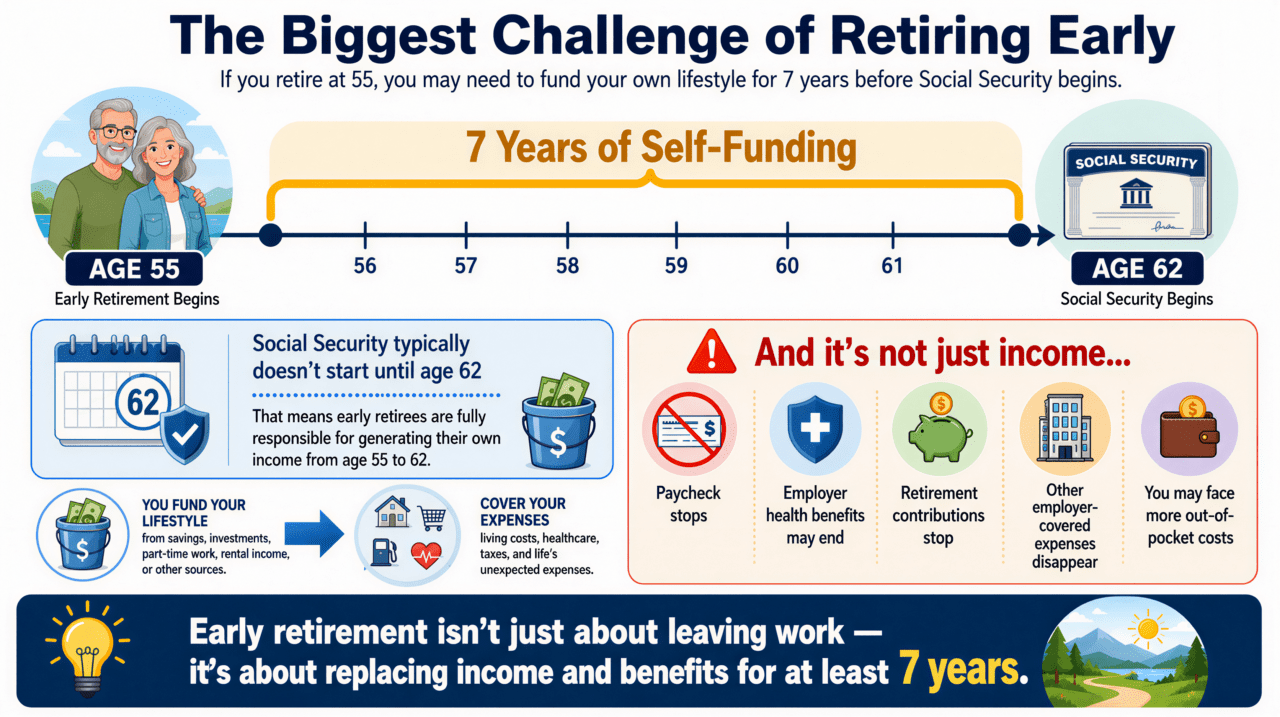
Healthcare is the clearest example. Once you’re off an employer health plan, coverage can cost $12,000 to $24,000 a year until Medicare eligibility at 65. Retire at 55, and that’s a 10-year stretch where healthcare alone could cost $120,000 to $240,000 out of pocket, before anything else you need to fund.
If you have a 401(k) through an employer, the Rule of 55 lets you withdraw from it penalty-free once you leave that job in or after the year you turn 55. If you have a traditional pension, or a self-built Hybrid Pension, you’re in an even stronger position, since you’ll have guaranteed income coming in regardless of when Social Security starts. We’ll come back to that strategy later in this article.
If retiring at 55 is a possibility for you, make sure you’ve mapped out two things clearly: the 7-year gap until Social Security, and the extra expenses your employer used to absorb. Both can drain savings faster than expected if they’re not planned for explicitly.
How Your Claiming Age Changes Your Benefit
Your Social Security check isn’t a fixed number, it shifts based on exactly when you decide to claim it.
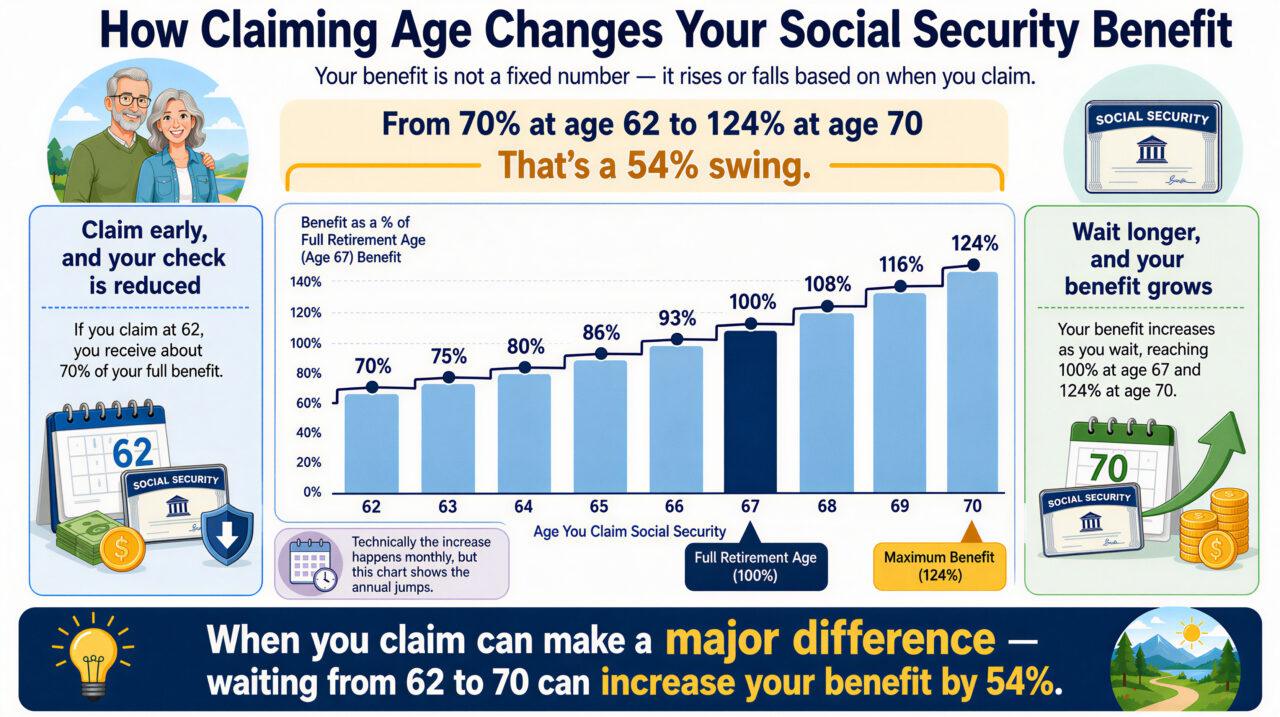
If you claim Social Security benefits at 62, you lock in a permanently reduced monthly check. If you wait to claim Social Security until age 70, your benefit grows about 8% per year past full retirement age, topping out at 124%. Between claiming at 62 and waiting until 70, that’s a 54% swing in your monthly benefit for life.
That naturally raises the next question: If I retire early, how much do the years I’m not working reduce what I get?
The 35-Year Rule (And What Zero Years Cost You)
Social Security doesn’t just look at when you claim benefits, it also looks at how many years you’ve worked. Specifically, your benefit is calculated from your 35 highest-earning years, averaged into a figure called your AIME (Average Indexed Monthly Earnings). If you haven’t hit 35 years working, every missing year gets recorded as a zero, and those zeros drag your AIME down.
Here’s an example: Say you averaged $60,000 a year over 30 years, roughly $1.8 million in lifetime earnings. Social Security still divides that total by 35, not 30, so your average drops to around $51,000.
| Scenario | Average Indexed Earnings | Estimated Monthly Benefit |
|---|---|---|
| Full 35 years at $60,000 | $60,000 | ~$2,200 |
| 30 years worked, 5 zero years | ~$51,000 | ~$1,900 |
| Difference | ~$300/month |
That $300-a-month gap works out to about $3,600 a year, or roughly $90,000 across a 25-year retirement, just from those 5 missing years.
Whether that difference matters depends on your situation. For some, $300 a month is the difference between a comfortable retirement and a stressful one. For strong savers with other income sources, it may not move the needle much at all. Either way, it’s worth running your own numbers before deciding.
Why Your Highest-Earning Years Matter More Than You Think
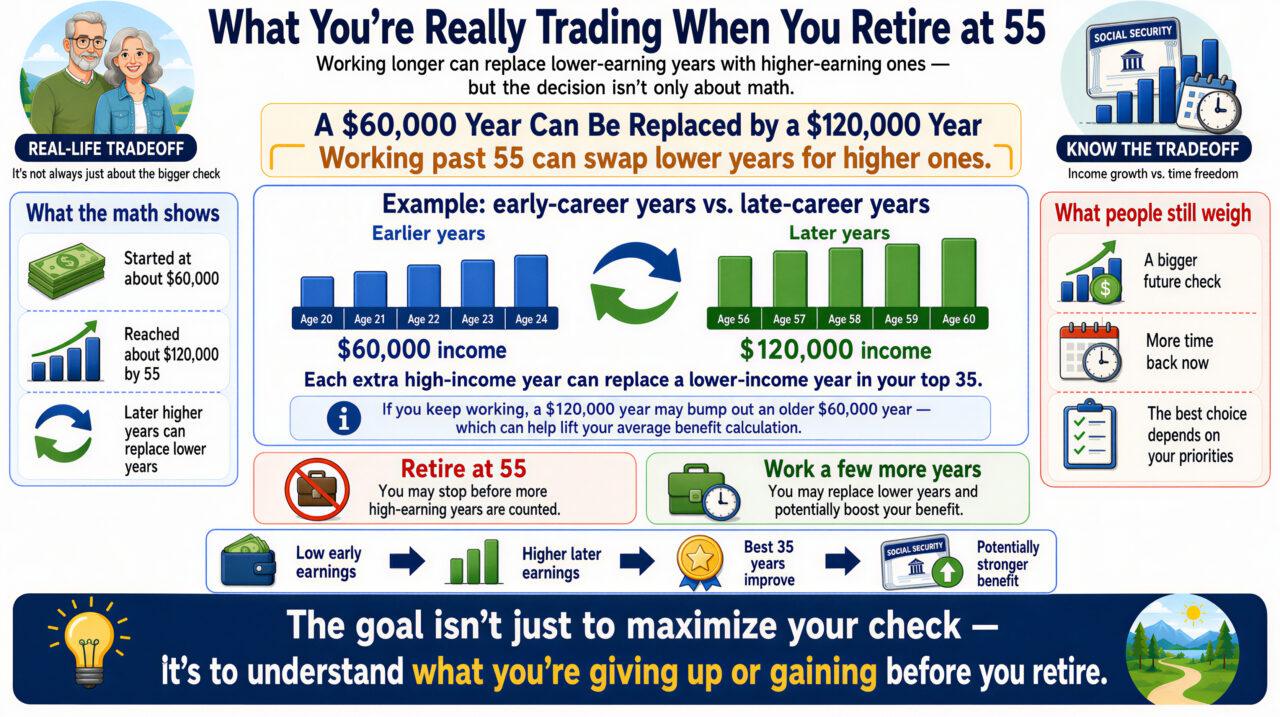
Here’s the part that catches people off guard: Social Security doesn’t average your first 35 years, it averages your highest 35 years. For most people, peak earning years come later in a career, in your 40s, 50s, and beyond. Even if you already have 35 years on the books, working a few more can replace your lowest-earning years with your current, higher-earning ones.
Wage Indexing: The Inflation Protection Built Into Your Check
If inflation is on your mind as you think about retiring early, there’s some good news: Social Security has inflation protection built directly into the formula, called wage indexing. Rather than using your raw historical earnings, Social Security adjusts each year’s earnings up to today’s value before calculating your AIME. A $40,000 salary from 1985 gets indexed to reflect what that income is worth in today’s dollars.
The catch: this indexing only applies to earnings before age 60. Anything earned after 60 counts at face value, without the same inflation adjustment. So working past 60 to boost your check still helps, but those later-year earnings don’t get the same boost your earlier years received.
The Hybrid Pension Solution
By now you’ve seen the 7-year gap, the cost of zero years, and what you might be walking away from in higher-earning years. For some, working those extra years genuinely isn’t worth it, whether for health reasons or simply wanting to enjoy more active years while there’s still energy for it.
The real question becomes: how do you replace the income you’d lose by claiming early, without depending on those extra working years?
Retirees who’ve already solved this tend to have one thing in common: a pension. A guaranteed paycheck arriving regardless of when Social Security starts means less pressure around the claiming decision entirely. Most retirees today don’t have an employer pension, but a similar structure can be built independently through a Hybrid Pension.
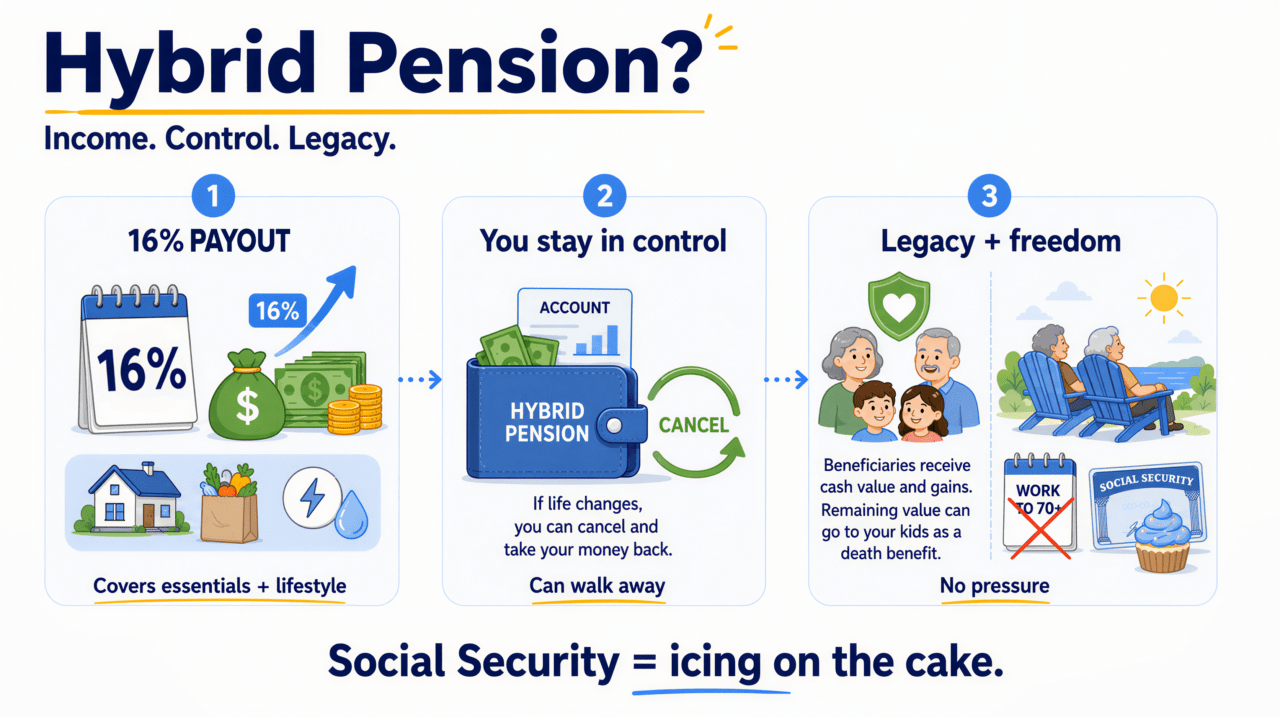
Here’s an example. Say you have $1.5 million saved. You put $1 million into a Hybrid Pension at 55, and defer it until 60. Like Social Security, the longer it sits, the higher the eventual payout. In this example, deferring to 60 locks in a 10% payout, or $100,000 a year in guaranteed income for life. (Payout rates vary by age, deferral period, and carrier; this example reflects one illustrative structure, not a universal rate.) How that income gets taxed alongside your other accounts depends on where it lands in your overall tax bracket.
With that kind of guaranteed income in place, Social Security shifts from being a necessity to what pensioners have always called it: icing on the cake. You can claim early without worrying about missing out, or delay it if you don’t need it yet, either way, the pressure around the decision is gone.
This is the exact strategy we’ve used ourselves. Our own Hybrid Pension reaches a 16% payout by the time we’re 60, covering our essential expenses so we’re not dependent on Social Security at all. What we value most about it is the control: if our situation changed, we could cancel and walk away with the funds. It also functions as a legacy tool, since the cash value and any gains pass to beneficiaries, and if both of us were gone, whatever’s left becomes a death benefit for our kids. The biggest win, though, is not feeling pressured to grind out extra years just to maximize a Social Security check that’s no longer carrying the full weight of our retirement.
The Emotional Side of Early Retirement
Retiring at 55 isn’t only a financial decision, it’s an emotional one, and it’s a part most retirement content skips entirely. Leaving the workforce means losing more than a paycheck: a daily routine, the people you used to see every day, and for some, a real piece of identity.
Nearly a quarter of retirees report struggling with this transition, and for some, that struggle can lead to real loneliness or even depression, especially if friends and family are still working during the day. None of this is a reason to avoid retiring early. It’s simply worth asking, alongside the financial questions, what you’ll actually do with your time. The people who navigate this transition best tend to have a plan for their time, not just their money, a hobby, a community, a sense of purpose, something to wake up for.
Frequently Asked Questions
Can I collect Social Security if I retire at 55?
No. Social Security benefits aren’t available until age 62 at the earliest. If you retire at 55, you’ll need to self-fund a gap of at least 7 years before benefits can begin.
How much does retiring early reduce my Social Security check?
Claiming at 62 instead of your full retirement age (typically 67) reduces your benefit to about 70% of what you’d receive at full retirement age. Waiting until 70 instead increases it to about 124%, a 54% total swing depending on when you claim.
What happens to my Social Security if I don't have 35 years of work history?
Any year short of 35 gets recorded as a zero in your earnings history, which lowers your AIME (Average Indexed Monthly Earnings) and reduces your monthly benefit. The exact impact depends on how those zero years compare to your actual working years.
Does Social Security account for inflation?
Yes, through a process called wage indexing, which adjusts your historical earnings to today’s dollar value before calculating your benefit. This indexing only applies to earnings before age 60.
How can I reduce my dependence on Social Security if I retire early?
Some retirees build a guaranteed income floor through tools like a Hybrid Pension, which can provide contractual lifetime income independent of when Social Security is claimed, reducing the pressure around that decision entirely.
See What Retiring at 55 Could Look Like for You
If you want to know exactly what your numbers look like, the income gap, your AIME, and whether a guaranteed income strategy makes sense for your situation, we can walk through it with you at no cost.
We represent over 50 plans across all 50 states, and because we’re paid directly by the insurance carriers, the consultation costs you nothing.
Schedule a free, no-pressure consultation with our licensed advisory team at KCIIS today.



Contact Us Get in Touch
Have a question or feedback?
Fill out the form below, and we’ll respond promptly!

By providing your name and contact information, you are consenting to receive calls, text messages, and/or emails from a licensed insurance agent about Medicare Plans at the number provided. You agree that such calls and/or text messages may use an auto-dialer or robocall, even if you are on a government do-not-call registry. This agreement is not a condition of enrollment.
Not connected with or endorsed by the United States government or the federal Medicare program. This is a solicitation of insurance, and your response may generate communication from a licensed producer/agent.