
The Different Types of Retirement Accounts, Explained
Retirement accounts confuse a lot of people, and the alphabet soup does not help. 401(k), 403(b), Roth IRA, HSA. They sound like a foreign language.
But underneath the jargon, the idea is simple. A retirement account is just a container, a bucket that holds your investments. What makes each bucket different is one thing above all: how it is taxed. Some let you deduct contributions now and pay taxes later. Some take taxed money now and pay you tax-free later. And one is not tax-advantaged at all, but gives you flexibility the others do not.
Below is a plain-English guide to the accounts that matter most, with the current 2026 contribution limits. Bookmark this page. At KCIIS, we reference these constantly when helping clients decide which bucket to draw from first in retirement, because how you take money out often matters more than which account it sat in.
A quick note: Contribution limits and income thresholds change every year. The figures below are for the 2026 tax year, based on IRS Notice 2025-67. This page is educational and is not individualized tax advice. Confirm your specific situation with a qualified tax professional.
The Three Tax Buckets
Before the individual accounts, here is the framework that makes all of them click. Nearly every retirement account falls into one of three tax categories:
| Bucket | Tax Going In | Tax Coming Out | Examples |
|---|---|---|---|
| Tax-deferred | Deductible now | Taxed as income later | Traditional 401(k), Traditional IRA |
| Tax-free | Already taxed | Tax-free later | Roth 401(k), Roth IRA |
| Taxable | No break | Capital gains rates | Brokerage account |
The magic of good retirement planning is having money in more than one bucket, so you can control how much taxable income you show in any given year. We will come back to that at the end.
Quick Comparison: Retirement Accounts at a Glance
| Account | Tax Treatment | 2026 Contribution Limit | Key Rule |
|---|---|---|---|
| Traditional 401(k) | Tax-deferred | $24,500 ($32,500 if 50+) | 10% penalty before 59½ |
| Roth 401(k) | Tax-free | $24,500 ($32,500 if 50+) | 5-year rule applies |
| 403(b) / 457(b) | Tax-deferred | $24,500 ($32,500 if 50+) | 457(b): no early-withdrawal penalty after leaving job |
| Traditional IRA | Tax-deferred | $7,500 ($8,600 if 50+) | RMDs at 73; deduction phases out at higher income |
| Roth IRA | Tax-free | $7,500 ($8,600 if 50+) | No RMDs; income limits to contribute |
| Rollover IRA | Tax-deferred | No limit (transfers only) | Preserves existing tax treatment |
| SEP-IRA | Tax-deferred | Up to 25% of pay, max $72,000 | Employer-funded; self-employed / small business |
| SIMPLE IRA | Tax-deferred | $17,000 ($21,000 if 50+) | Small businesses under 100 employees |
| Spousal IRA | Traditional or Roth | $7,500 ($8,600 if 50+) | Fund a non-working spouse's IRA |
| HSA | Triple tax-advantaged | $4,400 single / $8,750 family | Requires high-deductible health plan |
| Brokerage account | Taxable | No limit | Long-term gains taxed at capital gains rates |
| Pension | Tax-deferred (employer-funded) | Set by employer | Guaranteed income, less control |
Ages 60 to 63 may contribute a higher "super" catch-up of $11,250 to workplace plans (total $35,750). HSA holders 55+ can add a $1,000 catch-up. Figures are for 2026 per IRS Notice 2025-67.
Workplace Plans
Traditional 401(k)
The 401(k) is the account most people know, and for good reason. It is offered through your employer, funded automatically from your paycheck, and often comes with a match, where your employer contributes alongside you up to a certain percentage of your salary. If your employer matches, contribute at least enough to capture the full match. It is the closest thing to free money in personal finance.
Contributions go in pre-tax, which lowers your taxable income for the year. Your money then grows tax-deferred until you withdraw it in retirement, at which point it is taxed as ordinary income. For 2026 you can contribute up to $24,500, or $32,500 if you are 50 or older. Withdraw before age 59½ and you generally face a 10% penalty on top of ordinary income taxes.
One detail worth knowing: employer contributions may be subject to a vesting schedule, meaning you earn full ownership of them over a set number of years. Your own contributions are always 100% yours from day one.
Roth 401(k)
A growing number of employers offer a Roth version alongside the traditional 401(k). The difference is the tax timing. You contribute after-tax dollars, so there is no deduction today, but qualified withdrawals in retirement are completely tax-free. The same $24,500 limit applies (combined across your traditional and Roth 401(k) if you split contributions), and unlike the Roth IRA, there are no income limits to participate. To withdraw earnings tax-free, you must satisfy the 5-year rule and be at least 59½.
The Roth 401(k) often makes the most sense earlier in a career, when you are in a lower tax bracket, or for high earners who are shut out of a Roth IRA by income limits.
403(b) and 457(b)
These are the workplace plans for people who do not work at traditional for-profit companies. A 403(b) is offered by nonprofits, schools, and religious organizations, and works almost identically to a 401(k), same pre-tax contributions, same 2026 limit of $24,500.
A 457(b) is offered by many state and local governments and some nonprofits. It has one standout feature: unlike a 401(k) or 403(b), you can withdraw your money penalty-free after you leave that employer, even before age 59½. That flexibility can be valuable for anyone planning to retire early. One caveat: money you rolled into a 457(b) from a 401(k) or 403(b) keeps the original plan’s penalty rules.
Individual Accounts
Traditional IRA
An IRA, or Individual Retirement Arrangement, is one you open yourself, with no employer needed. A traditional IRA is tax-deferred like a traditional 401(k): you may be able to deduct contributions now and you pay ordinary income tax on withdrawals later.
For 2026 you can contribute up to $7,500, or $8,600 if you are 50 or older. (The catch-up rose to $1,100 for 2026, its first increase in nearly two decades.) Whether you can deduct the contribution depends on your income and whether you or your spouse has a workplace plan. For 2026, the deduction phases out between $81,000 and $91,000 for single filers covered by a workplace plan, and between $129,000 and $149,000 for married couples filing jointly. Withdraw before 59½ and the same 10% penalty generally applies.
Traditional IRAs are also subject to required minimum distributions (RMDs) starting at age 73, the IRS eventually makes you draw the money down so it can be taxed. Planning around those RMDs is a core part of retirement tax strategy.
Roth IRA
The Roth IRA is one of the most powerful accounts available to retirement savers. You contribute after-tax dollars, and qualified withdrawals, including all the growth, come out completely tax-free. Crucially, a Roth IRA has no required minimum distributions during your lifetime, so the money can keep growing tax-free for as long as you want, which makes it a valuable estate-planning and tax-management tool.
The 2026 contribution limit is the same $7,500 (or $8,600 if 50+), but there is an income ceiling to contribute directly: eligibility phases out between $153,000 and $168,000 for single filers, and between $242,000 and $252,000 for married couples filing jointly. To withdraw earnings tax-free you must be 59½ and satisfy the 5-year rule. (Higher earners who exceed the income limits sometimes use a “backdoor” Roth strategy, which is worth discussing with a professional.)
| Choose Traditional if... | Choose Roth if... |
|---|---|
| You expect a lower tax bracket in retirement | You expect the same or a higher bracket |
| You want the tax deduction now | You want tax-free income later |
| You are a high earner today | You want to avoid required minimum distributions |
Rollover IRA
A rollover IRA is not a different type of account so much as a landing spot. When you leave a job, you can roll your old 401(k) or 403(b) into an IRA rather than leaving it behind or cashing it out. This preserves the tax treatment you already earned, and it usually opens up a far wider range of investment options than a workplace plan offers. It is also a clean way to consolidate several old workplace accounts into one place. There is no contribution limit because it holds money transferred from another account, not new contributions.
Self-Employed and Spousal Options
SEP-IRA and SIMPLE IRA
If you are self-employed or own a small business, two accounts let you save far more than a regular IRA.
A SEP-IRA (Simplified Employee Pension) is funded entirely by the employer, which, if you are self-employed, means you. For 2026 you can contribute up to 25% of compensation, to a maximum of $72,000. That is roughly ten times the regular IRA limit, which makes it a powerful tool for high-earning solo business owners. If you have employees, you generally must contribute the same percentage for each of them.
A SIMPLE IRA (Savings Incentive Match Plan for Employees) is built for small businesses with fewer than 100 employees. It allows both employee and employer contributions, with a 2026 employee limit of $17,000, plus a $4,000 catch-up if you are 50 or older. It has lower limits than a SEP but allows employee salary deferrals, which a SEP does not.
Both are tax-deferred and work much like a traditional IRA once the money is in.
Spousal IRA
Normally you need earned income to contribute to an IRA. A spousal IRA is the exception: it lets a working spouse fund an IRA on behalf of a non-working or low-earning spouse, as long as the couple is married and files jointly. Each spouse still owns their own separate account, and it can be a traditional or Roth IRA with the same $7,500 (or $8,600 if 50+) limit. For households where one spouse has stepped back from work, it is an easy way to keep both partners saving in tax-advantaged accounts.
The HSA: The Stealth Retirement Account
Most people think of a health savings account as a way to pay medical bills, and it is. But it is also arguably the most tax-advantaged account in existence, and one of the best-kept secrets in retirement planning.
The HSA is triple tax-advantaged: contributions go in pre-tax, the money grows tax-free, and withdrawals for qualified medical expenses are tax-free. No other account does all three. For 2026 you can contribute up to $4,400 for individual coverage or $8,750 for family coverage, plus a $1,000 catch-up if you are 55 or older. You must be enrolled in a high-deductible health plan to contribute.
| The HSA Triple Tax Advantage | What It Means |
|---|---|
| Tax-free going in | Contributions lower your taxable income |
| Tax-free growth | Investments grow with no tax drag |
| Tax-free coming out | Withdrawals for medical costs are untaxed |
Here is the retirement angle: if you can afford to pay medical bills out of pocket during your working years and leave the HSA invested, it becomes a powerful long-term account. After age 65, you can withdraw HSA funds for any purpose without the usual 20% penalty (you would just pay ordinary income tax on non-medical withdrawals, exactly like a traditional IRA). And healthcare in retirement is expensive, so a dedicated, tax-free bucket for it is enormously useful. HSAs also have no required minimum distributions.
The Account Most Guides Forget: The Taxable Brokerage Account
The big-name guides to retirement accounts tend to skip this one, but for anyone planning retirement income, it may be the most strategically important account of all.
A standard brokerage account has no contribution limits, no income limits, and no withdrawal rules. You can put in as much as you want and take it out whenever you want. What you give up is the upfront tax deduction. What you gain is flexibility, and a major tax advantage most people overlook.
When you sell investments held longer than a year in a brokerage account, the growth is taxed at long-term capital gains rates, not ordinary income rates. And depending on your total taxable income, some retirees pay 0% on those gains. (See our guide to the 2026 tax brackets for the exact capital gains thresholds.)
This is why the brokerage account is often the single best place to draw income from in the early years of retirement, especially the years you are deferring Social Security or a Hybrid Pension. It lets you generate spendable cash while keeping your taxable income low. Any serious retirement income plan uses it deliberately.
Pensions and the Modern Alternative
A traditional pension, or defined benefit plan, is not really an account you own. Your employer sets aside and invests money on your behalf, and in exchange guarantees you a set income in retirement, often for life. Pensions have become rare in the private sector, but they remain the gold standard for one reason: guaranteed lifetime income you cannot outlive.
That guarantee is exactly what most modern retirees are missing. A 401(k) or IRA hands you a pile of money and leaves you to figure out how to make it last. A pension hands you a paycheck.
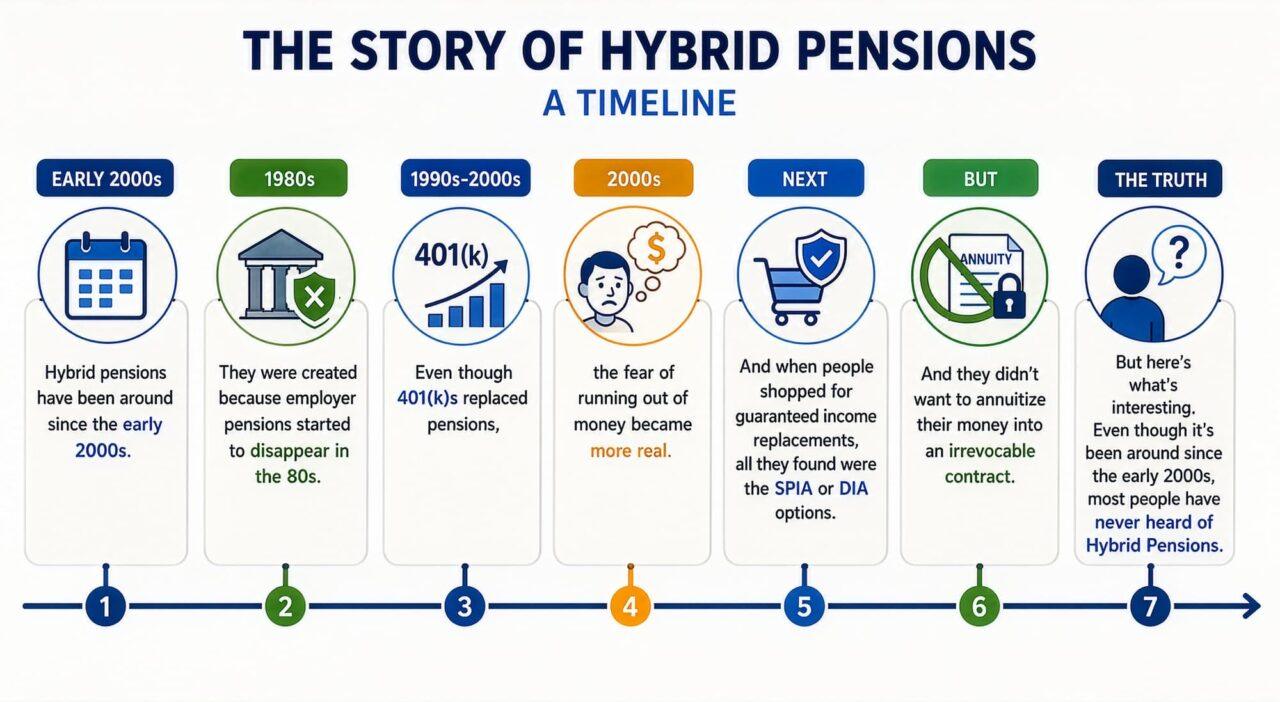
This is where a Hybrid Pension comes in. It is a fixed indexed annuity with a lifetime income rider, and it is designed to recreate the pension experience for people who never had one: guaranteed income for life, while keeping access to your cash value and the ability to leave a balance to your heirs. For many of our clients, funding a Hybrid Pension is how they turn a portion of their 401(k) or IRA into the pension their employer never gave them.
How These Accounts Work Together in Retirement
Here is the part most guides leave out. Choosing accounts is only half the job. The other half, the half that actually determines how much you keep, is deciding which accounts to draw from, and in what order, once you retire.
Because each bucket is taxed differently, the withdrawal sequence is a lever you control. Pull from a brokerage account in a low-income year and you might pay 0% on the gains. Pull too much from a traditional IRA and you could push yourself into a higher bracket, or trigger higher Medicare premiums. Convert some traditional money to Roth in the right years and you can shrink your future required minimum distributions.
This coordinated approach is the heart of our Staging and Laddering strategy, which divides your money into buckets and sequences your withdrawals to minimize taxes across your whole retirement, not just one year at a time.
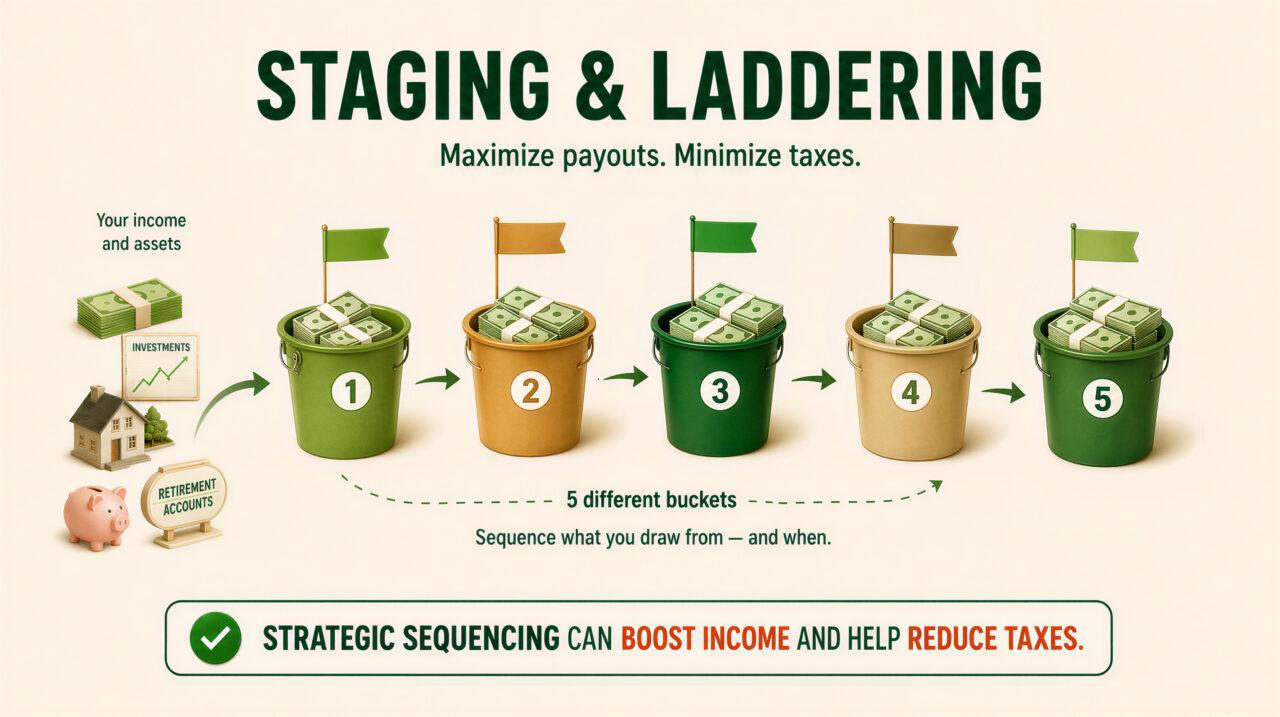
The accounts are the containers. The strategy is what fills your retirement paycheck.
Frequently Asked Questions
What is the difference between a traditional and a Roth account?
It comes down to when you pay taxes. With a traditional account (401(k) or IRA), you deduct contributions now and pay ordinary income tax when you withdraw in retirement. With a Roth account, you pay taxes on contributions now, but qualified withdrawals in retirement are completely tax-free. Traditional often wins if you expect to be in a lower tax bracket in retirement; Roth often wins if you expect to be in the same or a higher bracket, or want tax-free money and no required distributions.
How much can I contribute to a 401(k) and an IRA in 2026?
For 2026, you can contribute up to $24,500 to a 401(k) ($32,500 if you are 50 or older, or $35,750 for ages 60 to 63). Separately, you can contribute up to $7,500 to an IRA ($8,600 if 50 or older). The 401(k) and IRA limits are separate, so you can contribute to both in the same year.
Can I have more than one type of retirement account?
Yes, and most people should. Having money in tax-deferred, tax-free, and taxable accounts gives you control over your taxable income in retirement, which is one of the most powerful tools for keeping your lifetime tax bill low.
Which account should I withdraw from first in retirement?
There is no universal answer, it depends on your tax situation each year. A common approach draws from taxable brokerage accounts first (to take advantage of low capital gains rates), then tax-deferred accounts, then Roth accounts last. But the optimal sequence is personal and is exactly what a coordinated income plan is designed to determine.
What retirement accounts can I use if I am self-employed?
The two most common are the SEP-IRA and the SIMPLE IRA. A SEP-IRA lets you contribute up to 25% of compensation (max $72,000 in 2026), making it ideal for high-earning solo business owners. A SIMPLE IRA has lower limits but allows salary-deferral contributions and suits small businesses with employees. A Solo 401(k) is another strong option worth discussing with a professional.
Ready to Put These Accounts to Work?
Knowing the accounts is the first step. Building a plan that draws from them in the right order, minimizes your taxes, and turns them into reliable lifetime income is where the real value is.
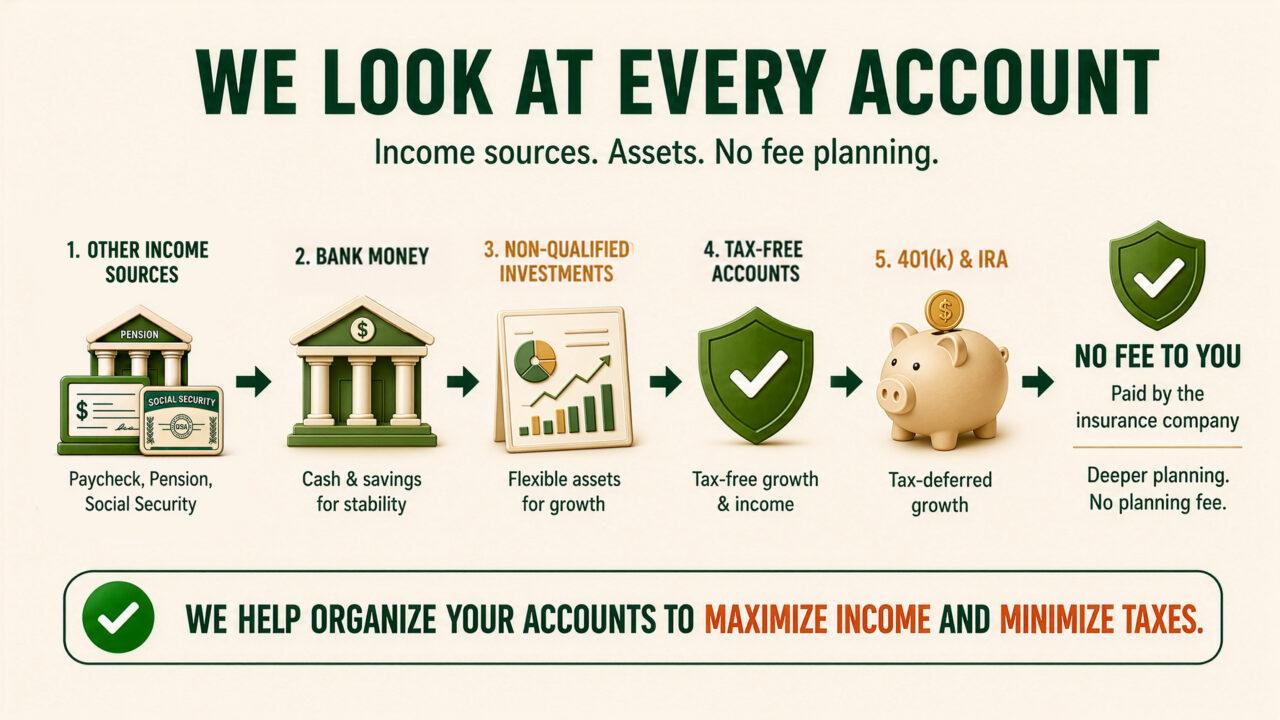
Schedule a free, no-pressure consultation with our licensed advisory team at KCIIS today. We will map your accounts against your goals and show you exactly how to turn your savings into a guaranteed retirement paycheck.



Contact Us Get in Touch
Have a question or feedback?
Fill out the form below, and we’ll respond promptly!

By providing your name and contact information, you are consenting to receive calls, text messages, and/or emails from a licensed insurance agent about Medicare Plans at the number provided. You agree that such calls and/or text messages may use an auto-dialer or robocall, even if you are on a government do-not-call registry. This agreement is not a condition of enrollment.
Not connected with or endorsed by the United States government or the federal Medicare program. This is a solicitation of insurance, and your response may generate communication from a licensed producer/agent.