
Imagine two people about to retire.
One has a $500,000 annuity. The other has $1 million invested in the S&P 500. Both have the goal of retiring comfortably and with peace of mind to spend the savings they’ve built without the fear of running out.
The question is: Who will be better off?
The answer is not what most people expect, and retirees who never run this comparison can end up with only half the income they could have had in retirement.
First, What We’re Actually Comparing
Before the numbers, one clarification that prevents almost every misunderstanding: an annuity payout rate is not a market return.
When we say a Hybrid Pension pays 10% or 15%, that is a contractual payout on your income, similar to how an employer pension or Social Security pays you a set amount for life. It is not an investment return, and it is not a claim that the annuity “earns” 15% in the market. A Hybrid Pension is a fixed indexed annuity paired with a lifetime income rider. Its payout is based on two things: your life expectancy and how long you defer before turning on income. The longer you defer and the older you are, the higher the contractual payout climbs.
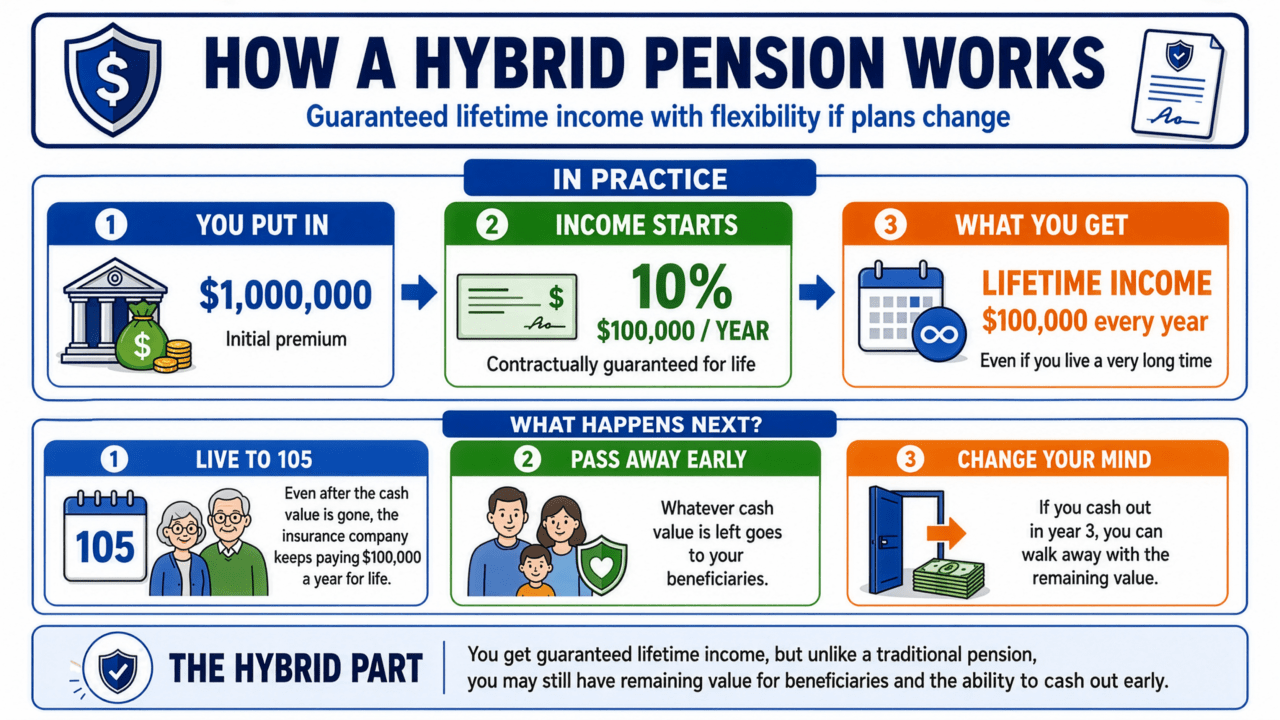
This matters because critics of annuities are right about one thing: you cannot get S&P 500 returns without taking S&P 500 risk. But that is not what a Hybrid Pension is doing. It is not trying to beat the market’s return. It is converting a lump sum into guaranteed lifetime income at a rate the market cannot contractually promise. Keep that distinction in mind and the comparison below makes sense.
To be clear about what a Hybrid Pension is not: it is not a variable annuity stacked with hidden fees, it is not a life insurance product, and it does not lock your money away permanently. You keep access to your cash value, and any remaining balance passes to your beneficiaries. If you’re new to how these work, our explainer on whether Hybrid Pensions are legitimate covers the mechanics in full.
Age 55: The Comparison That Shouldn’t Be Close
Meet Melissa and Ethan. Both are 55, both have $500,000, and both want income starting at 65.
Melissa puts her $500,000 into a Hybrid Pension and defers for 10 years. Her cash value grows at a conservative average of about 6%, ending near $895,000. Ethan keeps his $500,000 in the S&P 500 for 10 years, averages 10.44%, and ends at roughly $1.35 million.
So who gets more income? Most people say Ethan, and it’s not close in their mind. He has $1.35 million; she has $895,000.
Now look at the actual income each produces.
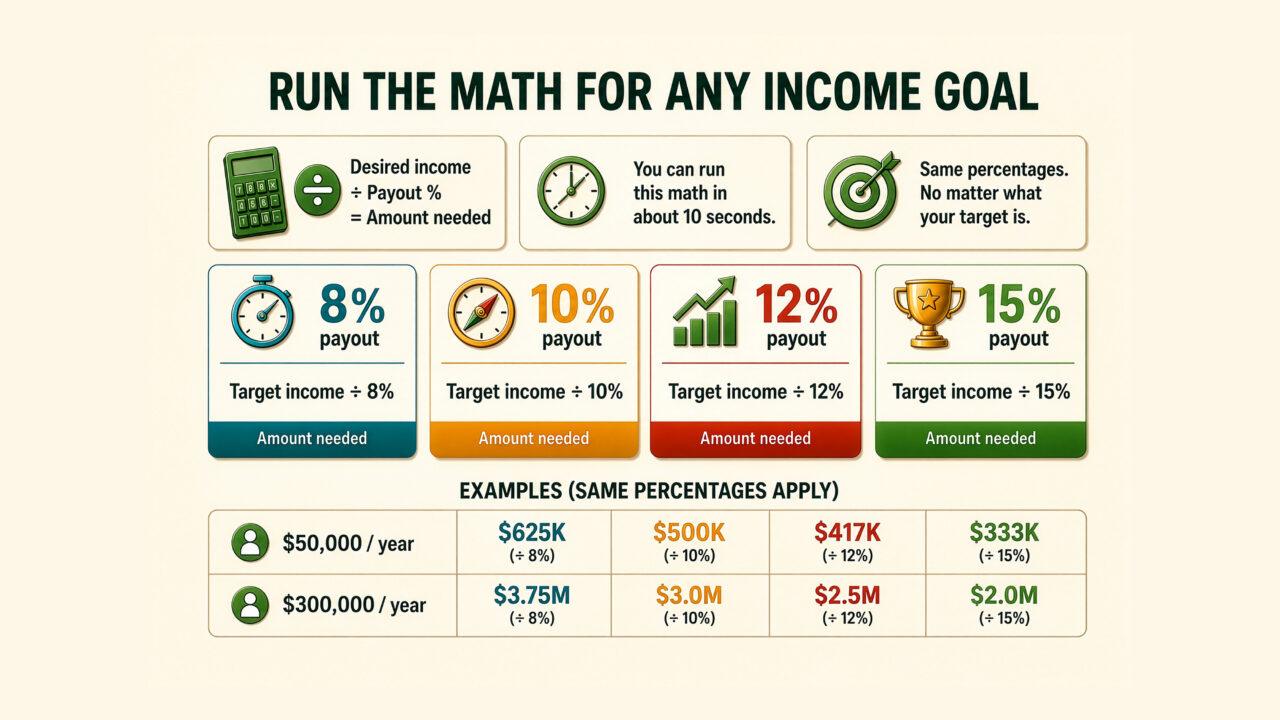
Using the 4% rule, Ethan’s $1.35 million generates $54,000 a year. Push him to a riskier 5% and he’s at $67,500. Anything higher and he risks running out before age 90.
Melissa’s contractual payout, meanwhile, grew from 6.3% at age 55 to 15.8% by deferring 10 years to age 65. On her original $500,000 deposit, that is $78,800 a year, contractually guaranteed for life. That is between $11,300 and $24,800 more every year than Ethan, from a starting amount that was $500,000 smaller.
| Metric | Melissa (Hybrid Pension) | Ethan (S&P 500) |
|---|---|---|
| Starting amount | $500,000 | $500,000 |
| Value after 10 years | $895,000 cash value | $1,350,000 |
| Annual retirement income | $78,800 (15.8% payout) | $54,000 – $67,500 (4–5% rule) |
| Guaranteed for life? | Yes, contractually | No, depends on the market |
Illustrative figures. Payout rates vary by carrier, age, and deferral, and move with interest rates.
How is that possible? Because Melissa’s income is a contractual payout, not an investment return. Pensions don’t care about market performance; they’re based on age and deferral. Even though her cash value only grew at 6%, her payout rate climbed to 15.8% because she was older and had deferred a decade. And you don’t have to wait the full 10 years, even a 5-year deferral gets the payout to around 10%.
Think of it like Social Security. Whether the market soars or crashes, your check doesn’t change. If your Hybrid Pension contract says 15.8%, your payout stays 15.8%, for life.
Why Ethan Can’t Just Withdraw More
Here’s where most people push back, and it’s a fair objection: “Ethan’s money is liquid. He can just withdraw more. Bump him from 4% to 6% and his $1.35 million pays $81,000, more than Melissa’s $78,800. So why buy the annuity at all?”
On paper, true. In real life, that is exactly where market-funded retirements fall apart.
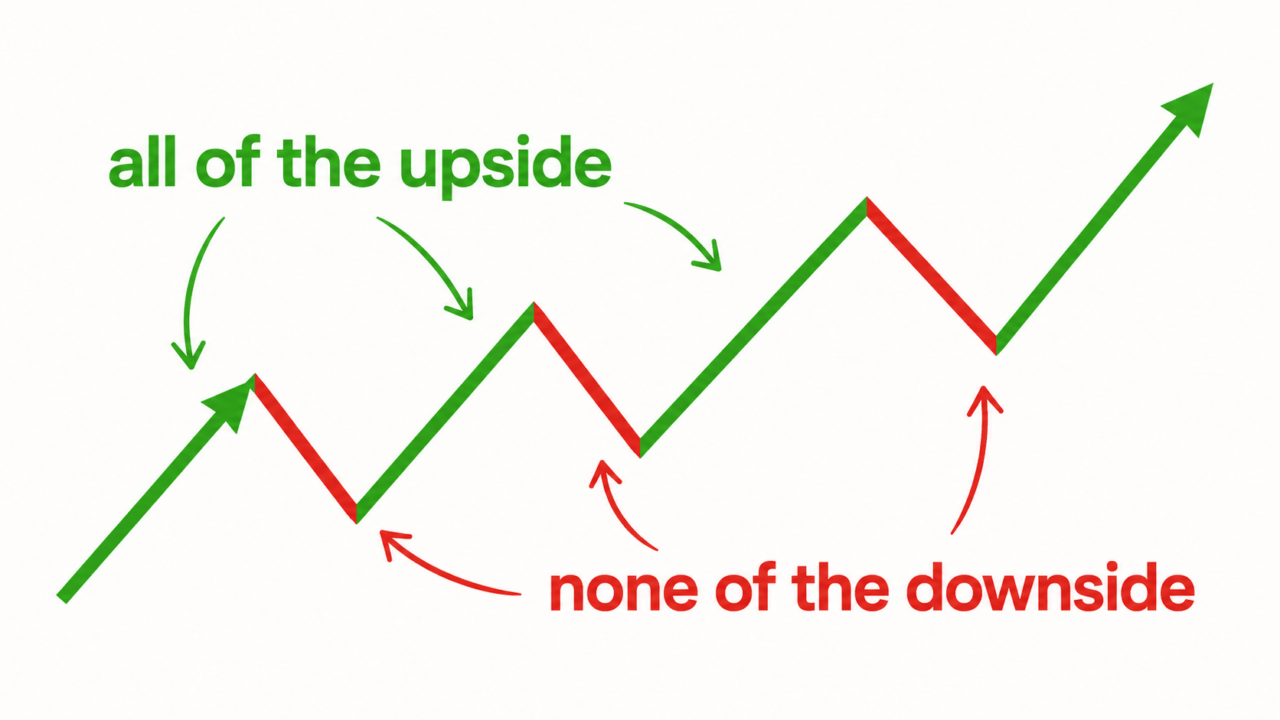
Ethan’s 10.44% is an average, and an average is hindsight math. When you’re retired, you don’t get the average, you get whatever the market hands you that specific year. Look at the S&P 500 from 2000 to 2010: drop, recovery, drop again. While you’re accumulating, the order of returns doesn’t matter. But once you’re retired and withdrawing, the order is everything. This is called sequence-of-returns risk.
If you pull living expenses out of an equity portfolio during a downturn, you’re forced to sell depressed shares to raise cash, leaving fewer shares to recover when the market rebounds. Losses early in retirement can permanently damage a portfolio it never fully recovers from. It’s like leaning your weight on a table leg you just glued, lean too soon and it collapses; even if it holds, the structure is already compromised.
So while the math says Ethan can take $81,000 a year, doing that through a bad early sequence could run him dry in his early 80s. Melissa’s contractual payout cannot be broken by a bad market year. That is the difference between “should last” and “guaranteed.”
Age 65: You Don’t Want to Wait
What if you’re not 55? What if you’re 65 right now and want income today?
Meet Amy and Aaron. Both are 65, both have $500,000. Amy puts hers into a Hybrid Pension and starts income immediately. Because she bought in at an older age, her payout is 7.3% rather than Melissa’s starting 6.3%, that’s $36,500 a year, guaranteed for life. Aaron keeps his in the market and withdraws: $20,000 at 4%, $25,000 at 5%.
So Aaron has $11,500 to $16,500 less income per year than Amy. Even starting immediately, with no deferral at all, the Hybrid Pension still wins, just not by a landslide.
| Metric | Amy (Hybrid Pension) | Aaron (S&P 500) |
|---|---|---|
| Starting amount | $500,000 | $500,000 |
| Income start | Immediately at 65 | Immediately at 65 |
| Annual income | $36,500 (7.3% payout) | $20,000 – $25,000 (4–5% rule) |
Illustrative figures. Even with no deferral, the Hybrid Pension produces $11,500 to $16,500 more per year.
Which raises the real question most people ask next: how do you delay the Hybrid Pension to get that bigger payout, while still enjoying retirement income now? That’s the strategy that changes everything.
The Staging & Laddering Strategy
Here’s the piece most retirees never see: deferring your Hybrid Pension does not mean delaying retirement. It means using other money to live on now while your payout grows in the background.
Most people we meet have several buckets: bank savings, a brokerage account, tax-free accounts, and 401(k)s or IRAs. We use those to fund the early years while the Hybrid Pension defers to a higher payout. We call this our Staging and Laddering strategy, and it does two jobs at once: it captures the highest possible payout, and it minimizes taxes along the way.
On the tax point: withdrawals from a non-qualified brokerage account are taxed at long-term capital gains rates, and depending on your total taxable income, some retirees pay very little, or even 0%, on those gains. That makes a brokerage account one of the most tax-efficient sources to live on while your Hybrid Pension defers. (Exact brackets change annually; confirm yours with a tax professional.)
Now watch the strategy in action. The highest payouts come from combining deferral with an older age. Amy uses her other funds to live on for five years and defers her Hybrid Pension from 65 to 70. Her payout jumps from 7.3% to 11.46%, that’s $57,303 a year, a 53% increase over starting at 65. Compare that to $1 million in the market: at 4% that’s $40,000, at 5% it’s $50,000. Amy’s $500,000 beats $1 million again.
Defer to 75 and her payout climbs to 18%, or $89,600 a year, roughly 2.5 times what she’d have gotten starting immediately. And here’s a detail worth pausing on: Melissa (who started at 55 and deferred 10 years) got 15.8%. Amy deferred the same 10 years but started older, so her payout is higher at 18%. Being older is not the disadvantage people assume, as long as you have other assets to live on in the meantime, an older start can actually produce a better payout.
Where Laddering Gets Powerful
Instead of one contract, Amy splits her $500,000 into two ladders of $250,000 each.
From 65 to 70, she lives on Social Security and her other funds. Then the first ladder turns on at 70 at an 11.46% payout: $28,652 a year for life. At that point she pulls less from her other funds. At 75, the second ladder turns on at an 18% payout: $44,798 a year for life, and now she needs nothing from her other funds.
Combine the two and her total Hybrid Pension income is $73,450 a year, guaranteed for life. To match that with the 4% rule, someone would need over $1.83 million saved ($1.83M × 4% = $73,450). Amy did it with $500,000.
| Income Source | Annual Amount |
|---|---|
| First $250,000 ladder (turns on at 70) | $28,652 |
| Second $250,000 ladder (turns on at 75) | $44,798 |
| Social Security | $48,000 |
| Total retirement income | $121,450 |
To match $73,450 of guaranteed pension income using the 4% rule, you would need over $1.83 million saved. Amy did it with $500,000.
And that’s before Social Security. Add her $48,000 benefit and her total retirement income reaches $121,450 a year:
- $28,652 (first $250,000 ladder)
- $44,798 (second $250,000 ladder)
- $48,000 (Social Security)
The takeaway most retirees get wrong: they assume being older means they can’t defer. The only real reason someone can’t defer is not having other funds to live on during the deferral years. If you do have other buckets, you can defer regardless of age, exactly like deferring Social Security. No other income? You start now. Enough in other buckets? You can wait longer than you’d expect, even at 65, and capture a bigger payout for it.
How the Numbers Apply to You
Three strategies, three very different outcomes. The right one depends entirely on your situation: your age, your other assets, your tax picture, and your goals.
At KCIIS, this is what our advisors do every day. We compare over 50 plans across all 50 states, so you get an unbiased comparison rather than whatever a single carrier is selling. When we build a plan, we break your funds into buckets to determine which to draw from first, how to minimize taxes, and where a Hybrid Pension fits, so you can enjoy retirement now while your payout grows.
Our consultations are free. We’re paid directly by the insurance companies, the same way your auto insurance agent is, so there’s no fee to you. And we’re not here to replace your financial advisor. Our goal is to give you the most comprehensive, unbiased picture of your options, including the payout numbers a market-only advisor isn’t licensed to show you.
Frequently Asked Questions
Is an annuity better than the S&P 500?
It depends on your goal. For long-term growth over decades, the S&P 500 has historically produced higher average returns. But for guaranteed lifetime income in retirement, a Hybrid Pension can produce more spendable income from a smaller amount, because its payout is a contractual rate based on your age and deferral, not a market return subject to sequence-of-returns risk. Many retirees use both: the market for growth, a Hybrid Pension for guaranteed income.
Can a $500,000 annuity really produce more income than $1 million in stocks?
Yes, in the right circumstances. A Hybrid Pension with a deferral strategy can pay a contractual rate well above the 4% to 5% a market portfolio can safely withdraw. In the examples above, a deferred $500,000 Hybrid Pension generates more guaranteed annual income than $1 million withdrawn from the market at 4%. The exact figures depend on your age, how long you defer, and current payout rates.
Isn’t a 15% payout too good to be true?
The 15% is a payout rate, not an investment return. It includes returning your own principal to you over time, plus a guaranteed lifetime income the insurance company is contractually obligated to pay. It is not a claim that the annuity earns 15% in the market. This is the same mechanism that lets a pension or Social Security pay you a set amount for life regardless of market conditions.
What is a Hybrid Pension?
A Hybrid Pension is a fixed indexed annuity paired with a lifetime income rider. It provides guaranteed lifetime income like a traditional pension, but you keep access to your cash value, can change your mind, and pass any remaining balance to your beneficiaries. Learn more on our Hybrid Pensions and Annuities page.
What happens if the insurance company fails?
Insurance carriers are regulated at the state level and required to hold strict reserves, and state guaranty associations provide an additional layer of protection. We cover this in detail in our guide on what happens if the insurance company goes bankrupt.
Ready to Run Your Own Numbers?
If you want to see how a $500,000 Hybrid Pension compares to your current market plan, side by side, using your actual age and goals, we can show you exactly what your payout would look like.
Schedule a free, no-pressure consultation with our licensed advisory team at KCIIS today. There’s no cost, just a clear look at how much guaranteed income your savings could actually produce.
Source: IRS Revenue Procedure 2025-32. Figures apply to tax year 2026, reported on returns filed in 2027. This page is for educational purposes and is not individualized tax advice. Tax situations vary significantly. Please confirm your specific circumstances with a qualified tax professional.
Frequently Asked Questions
Is an annuity better than the S&P 500?
It depends on your goal. For long-term growth over decades, the S&P 500 has historically produced higher average returns. But for guaranteed lifetime income in retirement, a Hybrid Pension can produce more spendable income from a smaller amount, because its payout is a contractual rate based on your age and deferral, not a market return subject to sequence-of-returns risk. Many retirees use both: the market for growth, a Hybrid Pension for guaranteed income.
Can a $500,000 annuity really produce more income than $1 million in stocks?
Yes, in the right circumstances. A Hybrid Pension with a deferral strategy can pay a contractual rate well above the 4% to 5% a market portfolio can safely withdraw. In the examples above, a deferred $500,000 Hybrid Pension generates more guaranteed annual income than $1 million withdrawn from the market at 4%. The exact figures depend on your age, how long you defer, and current payout rates.
Isn't a 15% payout too good to be true?
The 15% is a payout rate, not an investment return. It includes returning your own principal to you over time, plus a guaranteed lifetime income the insurance company is contractually obligated to pay. It is not a claim that the annuity earns 15% in the market. This is the same mechanism that lets a pension or Social Security pay you a set amount for life regardless of market conditions.
What is a Hybrid Pension?
A Hybrid Pension is a fixed indexed annuity paired with a lifetime income rider. It provides guaranteed lifetime income like a traditional pension, but you keep access to your cash value, can change your mind, and pass any remaining balance to your beneficiaries.
What happens if the insurance company fails?
Insurance carriers are regulated at the state level and required to hold strict reserves, and state guaranty associations provide an additional layer of protection. We cover this in detail in our guide on what happens if the insurance company goes bankrupt.



Contact Us Get in Touch
Have a question or feedback?
Fill out the form below, and we’ll respond promptly!