
The Richest-Person-in-the-Graveyard Trap
What’s worse than running out of money in retirement? Being too afraid to spend it while you’re alive and dying rich.
Don’t be the richest-person-in-the-graveyard.
Here’s what’s surprising: One certain group of retirees have figured out how to spend without the fear of running out. According to the National Bureau of Economic Research, roughly 46% of Americans can fully fund their retirement and maintain a high standard of living, largely thanks to pensions and Social Security, safely spending their savings down to nearly zero without fear of running out.
Retirees without a pension tend to die with the bulk of their wealth untouched. The usual explanation is that retirees naturally spend less as they age. But retirees with more guaranteed income don’t show that same spending decline. In fact, their spending stays consistent, and in some cases, even increases with age.
The truth is, retirees whose retirements are solely funded by their 401(k) or savings don’t spend less because they want to. These retirees spend less because they’re afraid of the future unknowns: inflation, medical bills, or market crashes.
This article walks through the three phases of retirement spending, and the income strategy that lets you actually spend what you saved without the fear of outliving your money.
Why “You’ll Naturally Spend Less As You Age” Is Wrong
Most mainstream retirement guidance leans on data like Fidelity’s, which shows spending dropping 22% from your late 50s into your late 60s, and another 19% by 75. The conclusion drawn is usually that people naturally spend less as they age because they have less energy and are less mobile.
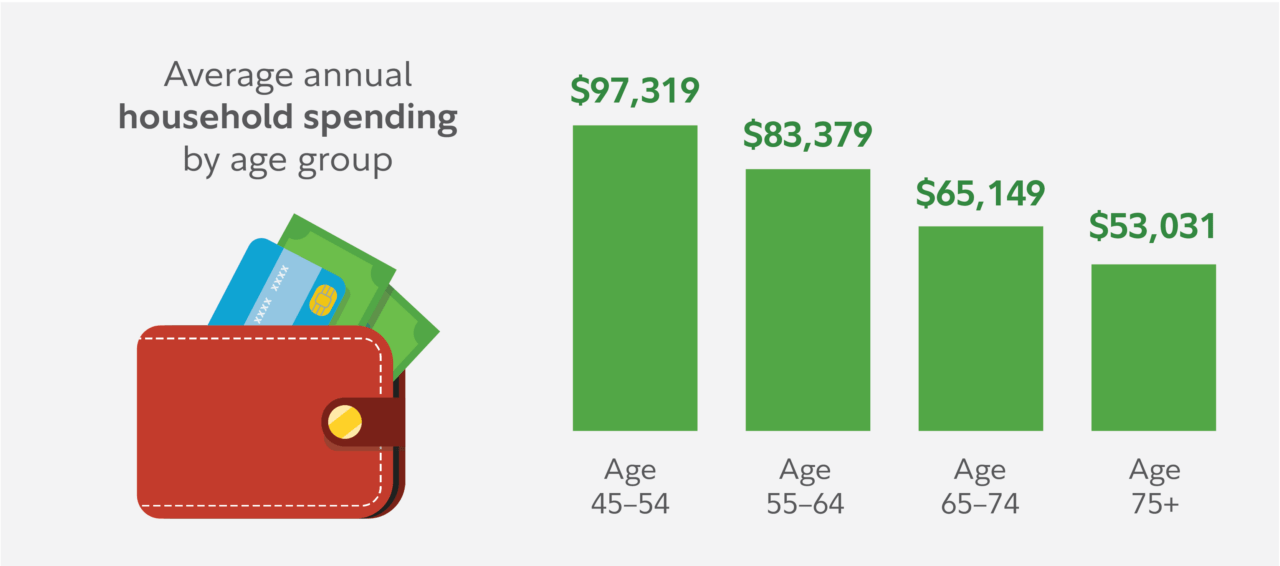
But research from Morningstar uncovers information that Fidelity’s data left out: that spending decline is concentrated almost entirely among retirees without a pension or annuity providing guaranteed income. Retirees with guaranteed income from pensions or annuities kept spending right through every phase of retirement.
Say you want $100,000 a year in retirement. The 4% rule requires that you save $2.5 million. If you factor in Fidelity’s data of decreasing spending as you age over 30 years, and you still need $2 million saved.
The reality is, saving $2 million is no more realistic than $2.5 million for most retirees. So what can you do?
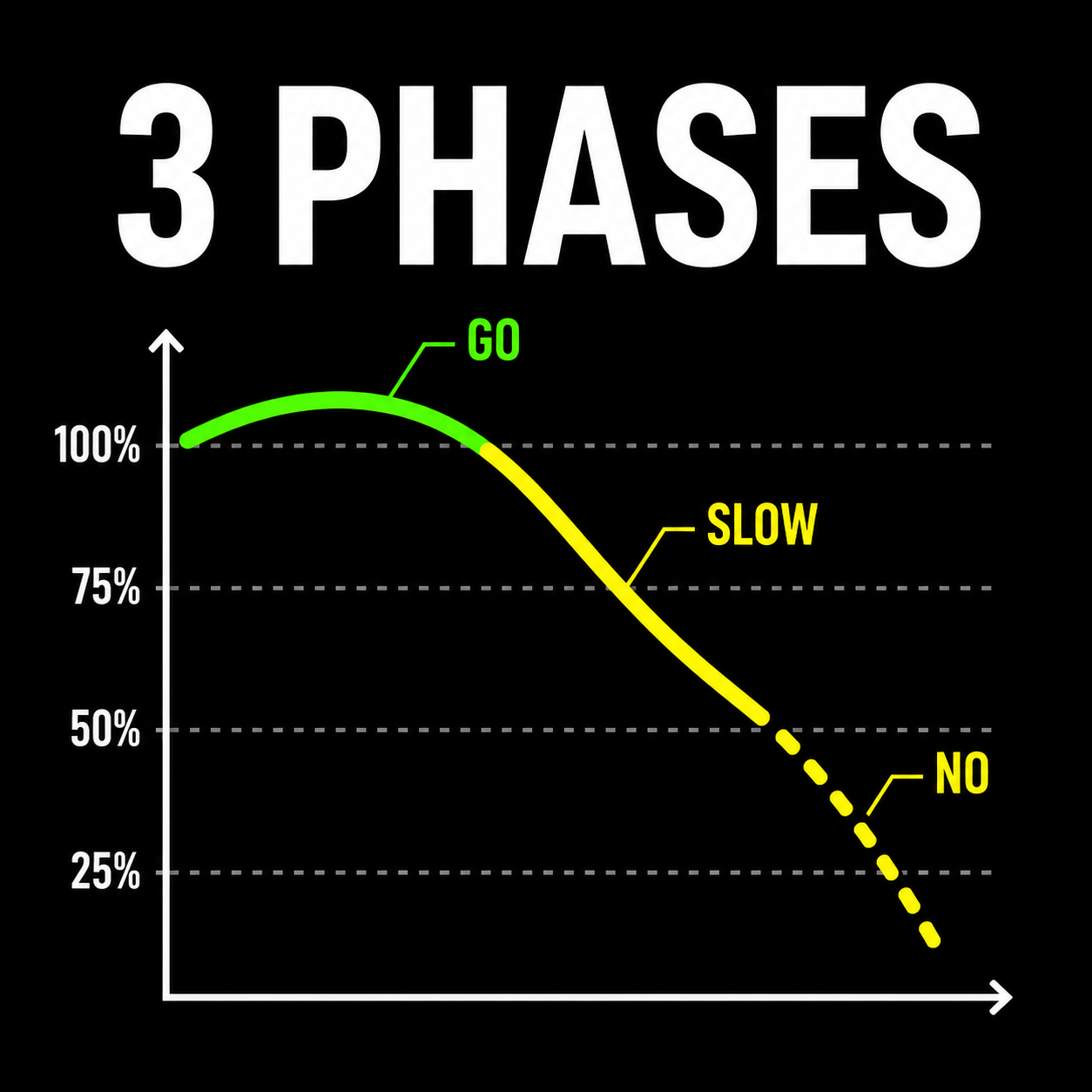
Think about retirement in three distinct phases.
| Phase | What Changes | What's Needed |
|---|---|---|
| Go-Go Years | Most energy, most bucket-list activity | A floor that lets you spend without waiting for "the market to feel right" |
| Slow-Go Years | Less energy, same desires, more need for convenience | A higher floor that covers accommodations, not just survival |
| No-Go Years | Health becomes the main variable | A floor that covers either long-term care or continued independence |
Phase 1: The Go-Go Years
These are the years right after retirement with the most energy. The years for crossing things off your bucket list: trips, time with grandkids, reconnecting with old friends. Most financial planners agree you should spend more money now, because a trip to Italy at 65 is NOT the same trip at 85.
Where that advice falls short: retirees who can spend during these years often don’t, because they know a single bad market year early in retirement could mean the portfolio never fully recovers.
A guaranteed income floor, Social Security plus a pension, an annuity, or a Hybrid Pension, changes that calculation entirely. Having income that doesn’t fluctuate with the market means your plans aren’t canceled because the S&P 500 had a bad year.
In your go-go years, a guaranteed income floor lets you spend the way you did when you had a paycheck from work, without relying on returns from the market.
Phase 2: The Slow-Go Years
Conventional advice says you’ll naturally slow down and spend less as you age. That means you’ll travel less, give up active hobbies, and spend more time at home. Spending data does support this. But slowing down doesn’t mean you stop wanting the same experiences, it just means you need more help doing them.
Planning your own itinerary, comparing every flight, walking 10 miles a day through a new city, that gets exhausting with age. What changes is the need for a personal tour guide, a car service, first-class seats on long flights so you actually arrive rested. Same trip. Higher cost of accommodation.
Bill Perkins, in his book Die With Zero, calls these experiences memory dividends. A trip isn’t just an expense, it pays you back in joy and memories for the rest of your life.
Think of it like a streaming subscription versus pay-per-view: It’s the same content, but a flat monthly fee means you don’t second-guess starting a new show. Pay-per-view means calculating whether each $8 movie is “worth it.” That’s the practical difference between retiring with a guaranteed income floor and retiring on a portfolio alone, the spending decision itself changes, even if nothing else does.
Most planners would say your income floor only needs to cover essentials: housing, food, healthcare, utilities. A stronger position is that your floor should cover the life you actually want, lifestyle included: the accommodations age requires, dinners out, hobbies, gifts for family, giving to causes you care about. If a pension covered your slow-go years, would you be afraid to spend it? A higher guaranteed floor doesn’t just keep you alive, it funds the parts of life that make retirement feel like retirement.
Phase 3: The No-Go Years
This is the phase Bill Perkins’ bestseller Die With Zero has reshaped how people think about, spend it all, don’t be the richest person in the graveyard. But most people who quote that idea miss what Perkins actually recommends first: securing longevity risk with guaranteed income before attempting to spend down to zero. In his own words, he advises using life insurance for mortality risk and annuities for longevity risk. Without that base income, “die with zero” quietly turns into running out at 87 and hoping family can help.
The math backs up why that base matters. For a healthy couple retiring at 65, there’s roughly a 50% chance one spouse lives into their 90s, and long-term care at that stage can easily run $100,000 a year or more. In the no-go years, a guaranteed income floor does one of two jobs: covering long-term care if it’s needed, or covering the continued support (housekeeping, meal help, transportation) that keeps you independent even if extensive care never becomes necessary. Either way, you don’t have to predict in advance which outcome your life will need, the income is there regardless, which is what takes the fear out of this phase entirely.
What Happens When Your Floor Is More Than You Need
Most retirees don’t end up needing extensive long-term care, which means the floor built to protect the no-go years can end up as surplus. The instinct is to treat that surplus as a bigger inheritance. That instinct, backed by research, tends to backfire.
A 20-year study by the Williams Group at Merrill Lynch, covering over 3,200 wealthy families, found that 70% of family wealth was lost by the second generation, and 90% by the third. Warren Buffett has long argued for giving children enough to do something, but not so much that they’re left with nothing to strive for. Perkins makes a related point: giving to children when they’re young, in their 20s, tends to have far more impact than an inheritance received decades later in their 60s.
Giving from income rather than principal, what we call a Living Legacy, lets you do exactly that without chipping away at your nest egg. In practice, that might mean helping with a down payment, investing alongside adult children in a rental property, or opening an account they manage themselves, gifts that teach how to handle money, not just receive it. For those without children, a living legacy can mean mentoring, sponsoring, or funding a cause you care about, and being alive to see its impact. When guaranteed income exceeds your necessities and lifestyle, the surplus becomes a legacy you get to give while you’re still here to watch it matter.
How to Actually Build This Income Floor
When people hear “guaranteed income floor,” the first thought is often, “isn’t that just an annuity?” If you’ve had a bad feeling about annuities, that instinct isn’t unfounded, plenty of annuities do lock up your money for life or carry hidden fees.
But annuities that provide guaranteed lifetime income without those drawbacks do exist, structured as a Hybrid Pension. It combines three things at once: guaranteed lifetime income, continued growth of your cash value, and access to your money if your plans change.
Payouts work differently than most people assume. Immediate income on most annuities runs 6% to 7%. A Hybrid Pension rewards deferral the same way Social Security does. (Payout rates are illustrative and vary by age, deferral period, and carrier; the ranges below reflect one example structure, not a universal rate.)
| Deferral Period | Illustrative Payout Range |
|---|---|
| Immediate | 6%-7% |
| 1-5 years | Up to 10% |
| 6-10 years | 12%-24% |
That range changes the required savings dramatically. To generate $100,000 a year: at a 10% payout, you’d need $1 million. At a 15% payout, roughly $666,000. Compare that to the 4% rule, which requires $2.5 million for the same income.
A real illustrative example. A 75-year-old client in good health didn’t want to buy traditional long-term care insurance, and at his age, it would have been expensive regardless. Instead, a portion of savings he wasn’t planning to touch unless care became necessary went into a Hybrid Pension. Deferring 10 years brings his payout to roughly 22.52%. Starting sooner, at 81, brings it to roughly 15.38% instead. He isn’t required to wait the full 10 years to access income, and even short of a long-term care need, that income can simply fund extra help around the house. The structure does two jobs at once: the cash value grows like a bond alternative, and the income functions like a real pension if and when long-term care becomes necessary.
This is the floor behind everything in this article. It’s what makes a three-phase spending plan actually work, what makes “die with zero” viable rather than reckless, and what makes a living legacy possible while you’re still here to see it.
Frequently Asked Questions
Why do retirees spend less as they age, even when they have enough money?
Research suggests it’s less about naturally wanting less and more about fear, of inflation, medical costs, or a market downturn. Retirees with guaranteed income from pensions or annuities don’t show the same spending decline as retirees living off savings alone, even at the same age and health level.
What does Bill Perkins' "Die With Zero" actually recommend?
Perkins advocates spending down your savings rather than leaving a large estate, but he specifically recommends securing longevity risk first through guaranteed income, like an annuity, before attempting to spend down principal. Without that guaranteed base, the strategy risks running out of money late in life.
What is a "Living Legacy"?
Giving to family or causes from your guaranteed income, rather than from savings or principal, typically while you’re alive to see the impact. Research suggests earlier gifts (such as to adult children in their 20s and 30s) tend to have more lasting impact than an inheritance received later in life.
How does a Hybrid Pension payout compare to the 4% rule?
A Hybrid Pension’s guaranteed payout rate is generally higher than the 4% withdrawal rate used in traditional planning, meaning less principal is required to generate the same income. Actual rates depend on age, deferral period, and carrier.
See What Your Income Floor Could Look Like
If you want to know what a guaranteed income floor could mean for your own retirement spending, whether that’s more freedom in your go-go years or a living legacy strategy for your family, we can walk through the numbers with you at no cost.
We represent over 50 plans across all 50 states, and because we’re paid directly by the insurance carriers, the consultation costs you nothing.
Schedule a free, no-pressure consultation with our licensed advisory team at KCIIS today.



Contact Us Get in Touch
Have a question or feedback?
Fill out the form below, and we’ll respond promptly!

By providing your name and contact information, you are consenting to receive calls, text messages, and/or emails from a licensed insurance agent about Medicare Plans at the number provided. You agree that such calls and/or text messages may use an auto-dialer or robocall, even if you are on a government do-not-call registry. This agreement is not a condition of enrollment.
Not connected with or endorsed by the United States government or the federal Medicare program. This is a solicitation of insurance, and your response may generate communication from a licensed producer/agent.