
Do you think $2 million is enough to retire?
Reaching the $2 million mark often creates a brand new problem that nobody warns you about. While everyone around you tells you that you are set for life, you don’t truly feel the freedom to spend what you have built. You are wealthy on paper. But the truth is, you are still afraid of what would happen to your portfolio in a market correction or crash. Because you have to stretch your savings for the next 20, 30, or even 40 years of retirement.
Over the past 21 years at KCIIS, we have met countless retirees who successfully saved $2 million or more. And what we found is that these retirees almost always fall into six specific retirement traps.
Let’s break down each one, and then discover the shift that gives retirees the mental freedom to spend what they worked so hard to save.
A quick note before we start: Tax figures reflect current federal brackets and change annually. Nothing here is individualized tax or investment advice. Always confirm your specific situation with a licensed professional.
Retirement Trap #1: The 4% Rule
Almost everyone measures retirement success by how much they have saved. But reaching $2 million rarely feels as satisfying as people expect.
Here is why. Out of a fear of running out of money, most retirees follow the 4% rule. That withdrawal rate was designed so your savings will hopefully last until age 90. It does not actually guarantee your money lasts forever. Following the 4% rule, retirees with $2 million never feel free to spend more than $80,000 a year. Because if they spend more, a market crash could end their retirement. And nobody wants to go back to work in their 80s.
Here is the bigger problem. If you saved over $2 million, you were most likely earning $120,000 to $150,000 during your working years. Now your income drops to $80,000 in retirement using the 4% rule. That permanent pay cut is why retirement often does not feel the way people imagined.
Yes, some expenses go away as you age, your mortgage may be paid off. But most people underestimate how expensive the early “go-go years” are. This is when you finally take the bucket-list trips and have the experiences you never had time for. You no longer take a two-week vacation; you have twelve months a year to go wherever you want. The problem is, an income of $80,000 does not cover much more than your bare necessities.
Retirement Trap #2: You Think a Bigger Portfolio Means a Better Retirement
The second trap is believing that a successful retirement simply means having a bigger portfolio.
The happiest retirees we meet with $2 million and up share two things.
- Their retirement income is the same as, or more than, what they earned while working.
- They spend freely without worrying about running out because they understand that income matters more than assets.
Think back to before 401(k)s existed. What did retirees do? The reality is, they didn’t need to save for retirement because their salary was replaced by a pension.
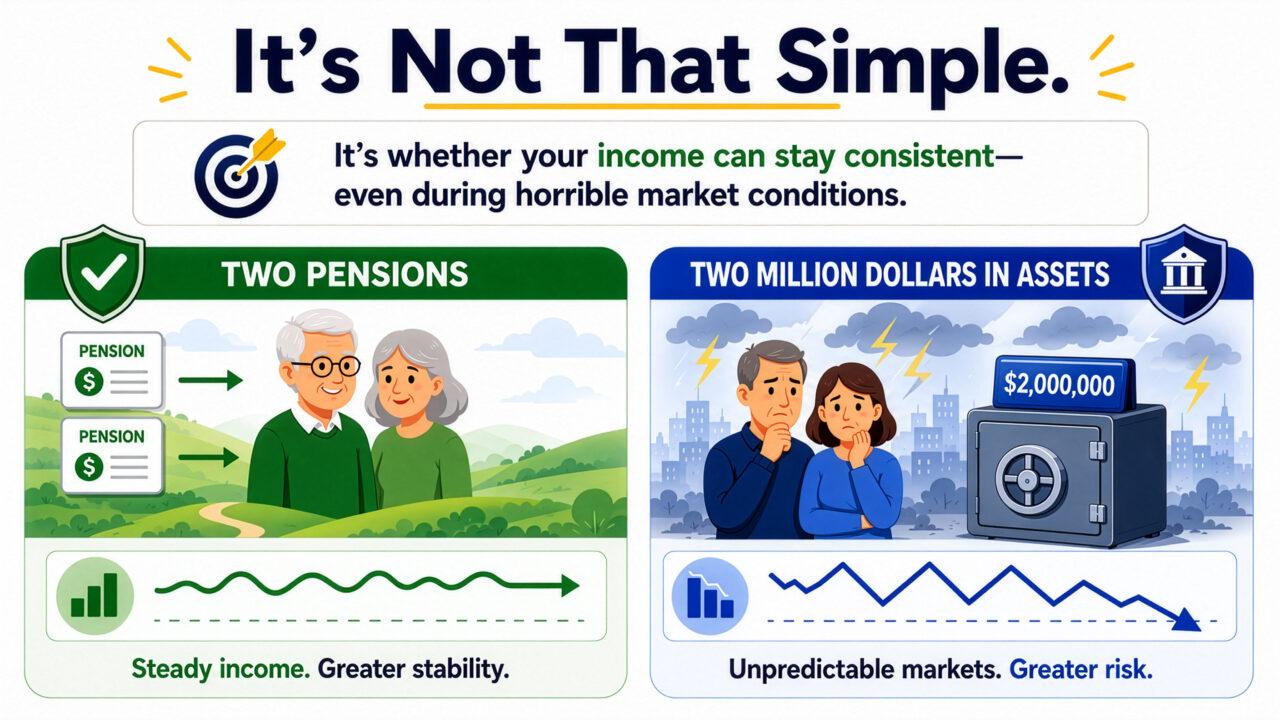
Today, teachers and government employees who stayed with the same pension plan for 20 or more years often retire with an income close to their working salary. And because that income is guaranteed, they don’t ever worry about running out. It is no surprise that retirees with a pension tend to be the happiest. Research on retiree well-being backs this up, which we cover in our comparison of annuities and other retirement options.
The obvious objection: most of us don’t have pensions. So why talk about them?
We reference our parents and grandparents that had pensions because it highlights what is missing in almost every retiree’s portfolio today: guaranteed income for life.
The truth is, your retirement income does not need to depend on your account size. Just as your paycheck while working was never tied to the stock market, your retirement paycheck doesn’t have to be either.
Retirement Trap #3: Believing Retirement Income Can Only Come From the Market
Ask a retiree where their retirement income comes from and the answer is almost always the same: Social Security and the market.
But here’s what most retirees miss. Besides Social Security, retirement income can come from three distinct sources:
- A traditional pension, a guaranteed income stream through your old job.
- A 401(k) or IRA, using market returns to generate income.
- A Hybrid Pension, a combination of the two.
While almost every retiree knows about traditional pensions, 401(k)s and IRAs, very few know that Hybrid Pensions are an option. A Hybrid Pension is a fixed indexed annuity with a lifetime income rider. It provides you guaranteed lifetime income like an employer pension, while letting you keep control of your money. Unlike a traditional pension or an immediate annuity that has no cash value. And if you change your mind at any point in the future, you can stop the income and cash out. If you pass away, the remaining balance passes to your beneficiaries.
And to be clear: a Hybrid Pension is not a variable annuity stacked with hidden fees, and it is not a life insurance product.
Guaranteed income is only available through insurance companies, not investment firms or brokerages. This is because only an insurance contract can promise income for life in writing. Social Security works the same way. You have paid FICA taxes for decades, and FICA stands for Federal Insurance Contributions Act.
The problem is, retirees find Hybrid Pensions, and see a payout of only about 6%. Why would anyone want that? They shouldn’t. The problem is they don’t know how to leverage the features of their Hybrid Pension.
Let’s go back to the example of $2.1 million in savings:
Under the 4% rule, $2.1 million produces about $84,000 a year. But, if you put the same $2.1 million into a Hybrid Pension in your early 60s and defer just four to five years, the contractually guaranteed income for the rest of your life is about 10%. That is roughly $210,000 a year guaranteed for life on $2.1 million. To generate that same $210,000 using the 4% rule, you would need a whopping $5.25 million saved. Expecting a portfolio to grow from $2.1 million to $5.25 million in four to five years is simply not realistic.
You don’t have to commit everything, either. If you put in $1.2 million at a 10% payout and you get $120,000 in guaranteed lifetime income, your remaining $900,000 can keep growing in the market. And with the right deferral strategy, payouts can climb to 12%, 15%, or more. You can read how those higher payouts are structured here.
Retirement Trap #4: You Measure Wealth Only by Your Account Balance
Almost every retiree measures wealth by a single number: their net worth. But the truth is, that is not the full picture. Real wealth also includes the total income you generate.
Go back to the $2.1 million example. Suppose you use $1.2 million for the Hybrid Pension and leave $900,000 invested. Because the Hybrid Pension already covers your income, that $900,000 can grow untouched for decades. This money you are not touching can ride out market volatility, and you are protected from the sequence of returns risk. Using historical S&P 500 returns over a long period as an illustration, an untouched $900,000 could grow to over $5 million over 20 to 30 years.
Now add the income you received every year for life. A 10% payout on $1.2 million is $120,000 a year. Over 30 years, that is $3.6 million in income you actually collected, on top of whatever the invested balance grew to. When you count both the income you received and the wealth you kept, the total often dwarfs what a pure market-withdrawal approach would have produced.
Retirement Trap #5: Inflation and Long-Term Care
Even if your income needs are met, two threats can quietly erode your retirement: inflation and long-term care. The question is not whether they will affect you. It is whether your strategy is guaranteed to protect against them.
This is a big reason people with $2 million stay frugal. If the 4% rule only provides you around $80,000, withdrawing extra to cover inflation or a long-term care event raises the real risk of running out.
Many people assume they can outpace inflation by staying in the market. That belief rests on the law of averages, which works beautifully while you are accumulating and not touching your money. But once you are retired and withdrawing every year, you face what is called sequence-of-returns risk: it is not the average return that determines your outcome, it is the order in which those returns arrive. A few bad years early in retirement, while you are pulling money out, can do permanent damage that a strong long-term average never repairs.
To be clear, a Hybrid Pension alone does not solve inflation either. Even a strong 10% to 20% payout is typically flat, meaning the income does not rise over time.
So how do you protect against rising costs?
This is where our proprietary Ladder OUT and Ladder IN strategy comes in. It is not the same as laddering CDs, bonds, or even ordinary annuities. Structured correctly, it is designed to build rising income over time and, in later years, capture significantly higher payouts. Combined with the right plan, this is how retirees can contractually protect against inflation and long-term care into their 90s and beyond.
Trap #6: You Forget That Taxes Don’t Retire When You Do
By now, your income is guaranteed, your investments are growing, and inflation is addressed. So you do the math: “If I’m bringing in $120,000 or $150,000 a year, I can live the way I used to while I was working.”
That math is wrong, because the money you bring in is not the money you get to spend. It sounds obvious, but we see this mistake all the time.
If you were used to spending $150,000 while working, replacing that income takes more than $150,000, because taxes don’t retire when you do. You need closer to $200,000 gross. But withdrawing $200,000 a year from a $2.1 million portfolio reintroduces the exact fear we started with, so most retirees settle for less.
Here is the trap in numbers. Say your Social Security is about $48,000 a year and you withdraw 4% of $2.1 million, or $84,000. That is $132,000 gross, which sounds like plenty, but after taxes your net income drops to roughly $109,000.
Now solve it with a Hybrid Pension. Using just $1.2 million at a 10% payout gives you $120,000 in guaranteed income. Add $48,000 in Social Security for $168,000 gross, and your net lands around $132,000, much closer to your goal. Defer for a 15% payout and the income rises to $180,000; add Social Security for $228,000 gross, and even after taxes you net roughly $170,000, using only $1.2 million.
Again, these are illustrative estimates. Your actual tax outcome depends on filing status, state, and account type.
How to Actually Fix This
Everything above is the framework. Putting it to work is where planning gets personal and genuinely complex, because it involves timing, taxes, RMDs, Roth conversions, and the order you withdraw from each account.
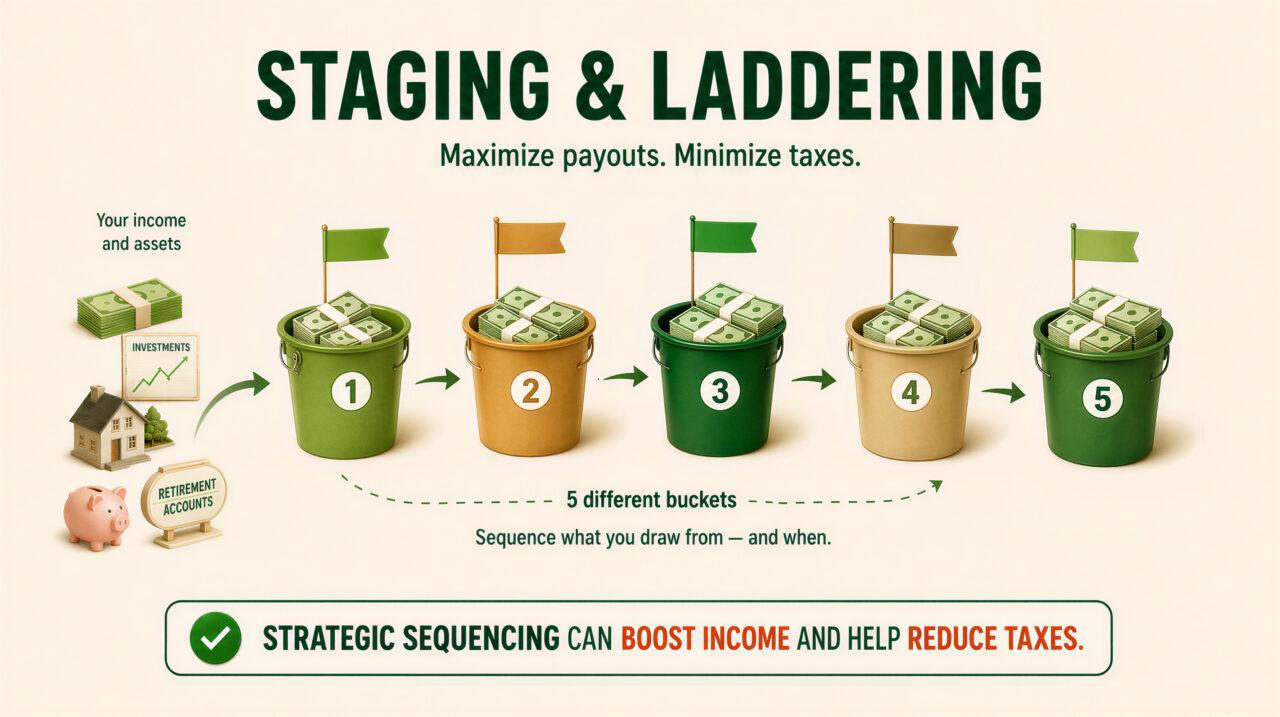
At KCIIS, this is what our team does every day. We compare over 50 plans and assist in all 50 states, so you get an unbiased comparison rather than whatever one carrier is selling. When we build your plan, we divide your funds into five stages to determine which to draw from first, how to minimize taxes, and where a Hybrid Pension fits.
The bottom line: You may not need millions more to spend freely in retirement. What you already have can often generate more than enough guaranteed income, if it is structured correctly.
Ready to See Your Real Numbers?
If you have saved and saved but still feel the fear of running out one day, know that we are here to help! We’ll walk through your specific situation and goals to provide a personalized recommendation of strategies.



Contact Us Get in Touch
Have a question or feedback?
Fill out the form below, and we’ll respond promptly!

By providing your name and contact information, you are consenting to receive calls, text messages, and/or emails from a licensed insurance agent about Medicare Plans at the number provided. You agree that such calls and/or text messages may use an auto-dialer or robocall, even if you are on a government do-not-call registry. This agreement is not a condition of enrollment.
Not connected with or endorsed by the United States government or the federal Medicare program. This is a solicitation of insurance, and your response may generate communication from a licensed producer/agent.