YouTube video coming soon!
The Real Reason Retirees Avoid Large Roth Conversions
Roth conversions can be a powerful way to reduce taxes later in retirement. But what stops most people isn’t the Roth itself, it’s the tax bill upfront, especially once you start talking about larger conversions.
So the question we hear most isn’t “should I do a Roth conversion?” It’s “how do I make up for the tax hit?” and “how long until I actually break even?” Those two questions, combined with the fear of jumping tax brackets or triggering Medicare surcharges, are exactly what keep people from converting more than a token amount.
Most advice on Roth conversions focuses on avoiding taxes later. This article focuses on something different: the fastest way to recover the taxes you pay upfront through the breakeven point. Relying on traditional recovery methods (a CD, or the market) can keep you playing catch-up for decades. Structured correctly, the breakeven point can come in 3 to 5 years, not decades. That’s the part almost nobody explains.
Why Breakeven Depends on Income, Not Growth
Here’s where most people misunderstand the math: they assume breakeven depends on market growth. It doesn’t. Breakeven is driven by income, specifically, how much income the converted dollars produce, how soon that income starts, and whether it’s reliable.
If your converted dollars are invested in the market, there is no guarantee of making up your tax hit in a reasonable amount of time. The unknown is why many never do any Roth conversions.
But what if you knew for a fact that you would make up your tax hit in just 2-4 years. Would you convert to Roth then? Of course.
As a bonus, when this is structured correctly, some retirees find they significantly reduce, or even eliminate, federal taxes on Social Security later on. Not because of a loophole, but because of the income strategy itself, which we’ll walk through below.
A Real Client Example: Bo’s $4.3 Million IRA
A viewer who called us, Bo, age 63, has about $12 million in total liquid assets, with roughly $4.3 million sitting in a Traditional IRA. That IRA is the main reason his future taxes could spiral once required minimum distributions begin.
Instead of converting everything at once, we suggested Bo convert about $614,000 per year for seven years, keeping him within the 35% marginal bracket.
Here’s where people get confused: being in the 35% bracket doesn’t mean all your money is taxed at 35%. What matters is your effective tax rate, what you actually pay on average once the lower brackets are filled first. (See how tax brackets actually work for the full breakdown.)
| Tax Component | Effective Rate |
|---|---|
| Federal tax | ~30% |
| State tax | ~10% |
| Long-term capital gains (on dollars used to pay the taxes) | 20% |
| All-in tax cost | ~70% |
That 70% figure is the combined tax cost on the dollars used to fund the conversion, and yes, that sounds painful. Because the tax bill is this massive, most people would stop here. But that’s a mistake.
The real question isn’t “is that a lot of tax?” It’s “how long does it take to make that money back?”
Three Ways to Recover the Tax Hit
There are three very different ways someone might try to recover a conversion’s tax cost through guaranteed income. Two of them take far too long.
| Recovery Method | Breakeven Timeline | The Catch |
|---|---|---|
| CD or MYGA at 5% | ~14 years | Assumes a consistent 5% for 14 straight years. From roughly 2009 to 2022, CDs and MYGAs actually averaged closer to 1–2% |
| Market at 8–10% | ~7 to 9 years | Assumes no sequence-of-returns risk, no major volatility, and no bad timing. From 2000 to 2010, four separate down years (2000, 2001, 2002, 2008) meant many investors never broke even at all |
| Hybrid Pension guaranteed income | ~3 years (this example) | Requires a contractually structured payout, not a market assumption |
Option 1: a CD at 5%. Starting from that ~70% tax cost, recovering it through a 5% CD or MYGA takes roughly 14 years, and only if that rate holds steady the entire time. It usually hasn’t.
Option 2: the market at 8% to 10%. This drops the breakeven to roughly 7 to 9 years, but not in every scenario. Live through a stretch like 2000 to 2010 instead, with four major down years, and that breakeven point can take much longer.
It’s exactly why disciplined savers still hesitate on large Roth conversions: not because the math is wrong, but because nobody knows in advance which stretch of history they’ll land in.
Option 3: a Hybrid Pension. Bo’s $4.3 million IRA was restructured into a Hybrid Pension, laddered so the conversions could happen in stages rather than all at once. In this example, each ladder produces a contractual guaranteed lifetime payout of 21.3%, which comes out to roughly $903,000 a year in tax-free income. (See how these rates are structured for the full mechanics. Bo’s 21.3% reflects his specific age and structure, not a universal rate.)
Compare that 21.3% guaranteed income to the ~70% tax cost, and Bo’s breakeven lands just over 3 years. Even accounting conservatively for lost investment opportunity and real-world friction, it’s still only around 5 to 6 years.
On top of the guaranteed lifetime income, a Hybrid Pension’s cash value continues to grow during deferral (conservatively 4% to 6%), and the ability to reinvest any unused portion of that tax-free income, and the breakeven compresses back toward 3 years even under conservative assumptions.
This is regardless of account size. Whether you’re converting $100,000 or $1 million, the same breakeven math applies, guaranteed income in the 15% to 20%+ range replaces the tax hit far faster than either traditional recovery method.
The Myth: Only Convert in a Low Tax Bracket
Common advice says to only do Roth conversions if you’re in a low bracket. If you follow this strictly, you’ll end up converting too little, and still end up facing the exact RMD problem they were trying to avoid. At the 12% to 24% brackets, the conversions tend to be so small they barely make a difference, the same “small hammer on a big slab of concrete” problem we’ve written about with RMDs.
Converting more upfront often trades a temporary, larger tax hit for a future where you land in the 10% bracket, with no Medicare IRMAA surcharge and potentially no tax on Social Security at all. That’s the trade most people never see modeled out.
Why Most Advisors Never Show You This
Most traditional advisors are trained to keep assets invested, not put into any type of guaranteed income products, in part because invested assets continue generating management fees. That naturally steers the conversation toward growth and legacy planning rather than conversion and recovery.
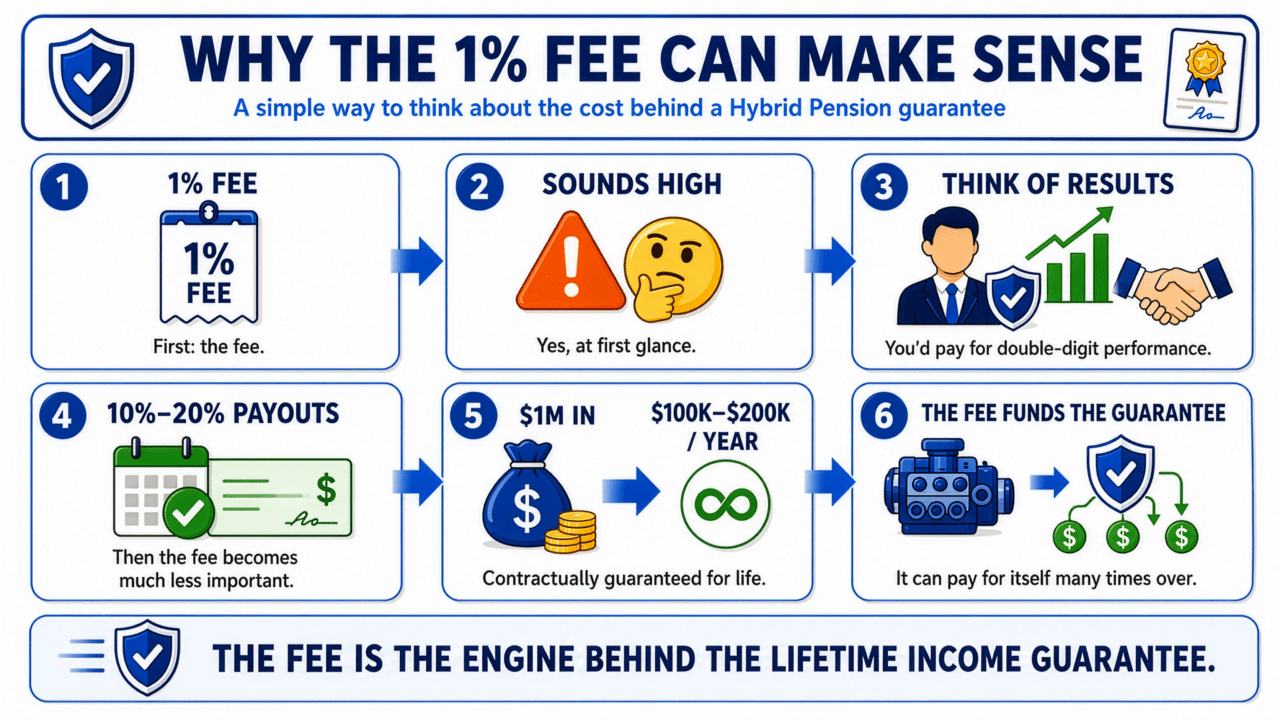
Money moved into a Hybrid Pension never has a management fee. Income riders often carry a 0% – 1% fee, but that fee comes out of the cash value, not the income payout itself.
Who This Strategy Works For (and Who It Doesn’t)
| This Strategy Doesn't Work If... | This Strategy Works Best If You... |
|---|---|
| You need your full IRA to survive on | Have accumulated outside assets beyond the IRA |
| You don't have outside assets to draw from | Don't need the IRA immediately to live on |
| You don't have a guaranteed income plan tied to the Roth | Have other funds available to use strategically during the conversion years |
It’s especially useful for people who are still working or recently retired, concerned about where future tax rates are headed, and tired of constantly thinking about how much they can withdraw while staying below the next tax bracket.
What Retirement Looks Like After the Conversions Are Done
Once the conversions are complete, the picture changes. No more required minimum distributions on the converted amount. Tax guessing largely disappears, and there’s no more pressure to time withdrawals just to cover bills. For many clients, that also means lower Medicare premiums and less, or no, taxation on Social Security.
The irony is that the more sophisticated strategy often produces the simpler retirement. When income is contractual and the taxes are already paid, the question stops being “can I afford this?” and becomes “what do I want my money to do now?”
Roth conversions were never really about avoiding taxes. They’re about recovering them, intentionally, and on a timeline you can actually plan around.
How long does it take to break even on a large Roth conversion?
It depends entirely on how the recovery is structured. A CD or MYGA can push breakeven upward of 14 years. Market growth typically lands in the 7 to 9 year range under favorable conditions, longer during a down decade. A guaranteed income structure like a Hybrid Pension, by contrast, can bring breakeven into the 3 to 5 year range, since it depends on a contractual payout rather than market performance.
Is it true that Roth conversions are only worth it in a low tax bracket?
Not necessarily. Waiting to be in a low tax bracket often means converting too little too late, and still facing a large RMD later. A larger, well-structured conversion earlier can trade a bigger upfront tax bill for a lower bracket, fewer Medicare surcharges, and less taxed Social Security down the road.
What is a micro-laddered Hybrid Pension conversion?
It’s a strategy where a Traditional IRA is split into multiple smaller Hybrid Pension “ladders” rather than converted all at once. Each ladder can be converted to a Roth Hybrid Pension on its own timeline, which helps manage the tax impact while still building toward a full conversion.
Does this strategy work with smaller account balances?
Yes. The breakeven math scales down the same way it scales up. Whether you’re converting $100,000 or several million, the comparison between guaranteed income and the tax cost works the same way.
Curious What Your Breakeven Would Look Like?
Your situation will look different from Bo’s, and possibly different from ours. That’s exactly why this is worth a real conversation rather than a generic calculator. We’ll walk through the actual math with you, including whether this is a strategy you should use at all.
We represent over 50 plans across all 50 states, and because we’re paid directly by the insurance carriers, the consultation costs you nothing.
Schedule a free, no-pressure consultation with our licensed advisory team at KCIIS today.



Contact Us Get in Touch
Have a question or feedback?
Fill out the form below, and we’ll respond promptly!

By providing your name and contact information, you are consenting to receive calls, text messages, and/or emails from a licensed insurance agent about Medicare Plans at the number provided. You agree that such calls and/or text messages may use an auto-dialer or robocall, even if you are on a government do-not-call registry. This agreement is not a condition of enrollment.
Not connected with or endorsed by the United States government or the federal Medicare program. This is a solicitation of insurance, and your response may generate communication from a licensed producer/agent.