
Why You’ve Probably Already Saved Enough
If you’re still working just to save “one more million,” stop and run the math first. Most people think they need a certain net worth to retire, and that’s not really their fault. Nearly every retirement calculator, article, and YouTube video falls back on the same strategy: save millions and you can safely withdraw $10,000 to $20,000 a month.
The problem is that advice is that it keeps you chasing money you may not actually need, or convinces you to downsize the retirement you actually wanted. This article walks through a better way to retire, one built around guaranteed income instead of market-based withdrawals, and why it can mean retiring with a fraction of what the traditional 4% rule requires. The truth is, once you have this much saved, work becomes optional and you can retire immediately.
The Real Flaw in Every Withdrawal Strategy
Nearly every mainstream retirement strategy, from the 4% rule to bucket strategies to the more conservative Guyton-Klinger guardrails approach, only safely allows 4% to 5.6% annual withdrawals. And the “safe withdrawal” percentage determines how much you need saved for any given retirement income goal.
Imagine this: You are 10 years old, and your parents only let you spend 4% of your allowance. To buy a $100 toy, you’d need $2,500 saved up. Even as a 10-year-old with $2,500, a genuinely large sum, you wouldn’t feel rich if you could only touch 4% of it a year. That’s essentially what most retirement strategies ask adults to do, but with millions of dollars.
| Desired Annual Income | Savings Needed (4% Withdrawal) | Savings Needed (5% Withdrawal) |
|---|---|---|
| $100,000 | $2.5 million | $2 million |
| $200,000 | $5 million | $4 million |
| $300,000 | $7.5 million | $6 million |
| $500,000 | $12.5 million | $10 million |
Even people who have this much saved often don’t feel wealthy. And real-world data on wealthier retirees, cited by outlets like Investopedia, has shown actual withdrawal rates are closer to 1.9% to 3%. So, why is this such a big problem?
Four traps of “safe withdrawal” strategies:
- Working longer than necessary to save an amount you think you need.
- Convincing yourself to downsize your retirement so that you can still retire when you hoped.
- Emotional guilt when you spend large amounts of money on travel, luxuries, or experiences.
- Dying with far more than expected, and wondering if you should have enjoyed yourself more while you still could.
But what if you simply just withdraw more than 4% to 5% per year? You risk the chance of running out of money. Especially if the market crashes early in your retirement, throwing off your whole plan. That’s called sequence-of-returns risk. So, what’s the solution?
The Missing Piece: A Guaranteed Income Floor
Here’s what’s missing from most retirement plans: a strong floor of guaranteed income that complements their market investments.
Think about Social Security. A high earner might collect around $62,000 a year in benefits. Divide that by the 4% rule, and it’s the equivalent of having $1.55 million in the market.
For those who have a pension AND Social Security, you may have $120,000 a year in combined guaranteed income. That’s equivalent to saving $3 million and living on the 4% rule. This is why retirees with a pension spend more and worry less than retirees who only have a 401(k).
Few understand this distinction: A paycheck is not an investment. What do we mean by that? Paychecks do not depend on market growth or need a return on investment (ROI) to generate income.
Our entire lives, we’ve been brainwashed to think that we need to grow our assets in order to create a retirement paycheck.
There are really only five income sources in retirement that function like an actual paycheck:
- Working income
- Social Security
- Employer pensions
- Traditional annuities
- Hybrid Pensions
Traditional annuities (SPIAs and DIAs) typically pay only 6% to 7% and lock up your principal permanently. A Hybrid Pension works more like a modernized pension: guaranteed income for life, but you keep control of your cash value, and any remaining balance passes to your beneficiaries if you pass away early.
The 10% to 15% Rule Compared to the 4% Rule
This is where the real difference in required savings shows up. Strategized well, guaranteed hybrid pensions pay in the 10% to 15% range, sometimes even higher. See how these payout rates are actually structured.
| Desired Annual Income | Needed at 4% Rule | Needed at 10-15% Rule |
|---|---|---|
| $100,000/year | $2.5 million | $666,000-$1 million |
| $200,000/year | $5 million | $1.3 million-$2 million |
| $300,000/year | $7.5 million | $2 million-$3 million |
| $500,000/year | $12.5 million | $3.3 million-$5 million |
| $1,000,000/year | $25 million | $6.6 million-$10 million |
Two retirees can have the exact same $100,000-a-year lifestyle.
One group used the 4% rule, so they needed to save $2.5 million to get there. The second group only had to use $666,000 for the same outcome. That’s FOUR TIMES LESS money to get the same income.
Think about the lifestyle you want to live in retirement. Not just your basic expenses.
Instead of looking at your bucket list and only accomplishing a few, think about all of the things on your bucket list that you would like to do.
How Hybrid Pension Payouts Actually Work
These payout rates aren’t a return on investment. No institution, not even a bank, can guarantee even 1% for life. So it’s absolutely fair to ask “How can an insurance company guarantee 10% to 15% payouts?”
Insurance companies that offer hybrid pensions use the same formula as Social Security and Employer Pensions: A x B = C.
“A” is your value (your salary for an employer pension, your lifetime earnings for Social Security, or your initial deposit for an annuity or Hybrid Pension). “B” is a multiplier that increases the longer you defer or the more you’ve earned. “C” is your resulting guaranteed annual income.
| If You Defer | Illustrative Payout Range |
|---|---|
| Immediate (50s) | 5%-6% |
| Immediate (60s-70s) | 6%-8% |
| 3 years | 8%-10% |
| 5 years | 10%-12% |
| 10 years | 15%-20% |
The Staging & Laddering Strategy
A common objection: “I wish I’d known this earlier, but I’m too old to defer now.”
The truth is, age matters less than whether you have other assets to live on while your Hybrid Pension defers, the same logic that applies to delaying Social Security. It’s not really about being 62 or 67. It’s about what else you have available to bridge the gap.
That’s the idea behind our Staging & Laddering strategy, distinct from laddering CDs or bonds.
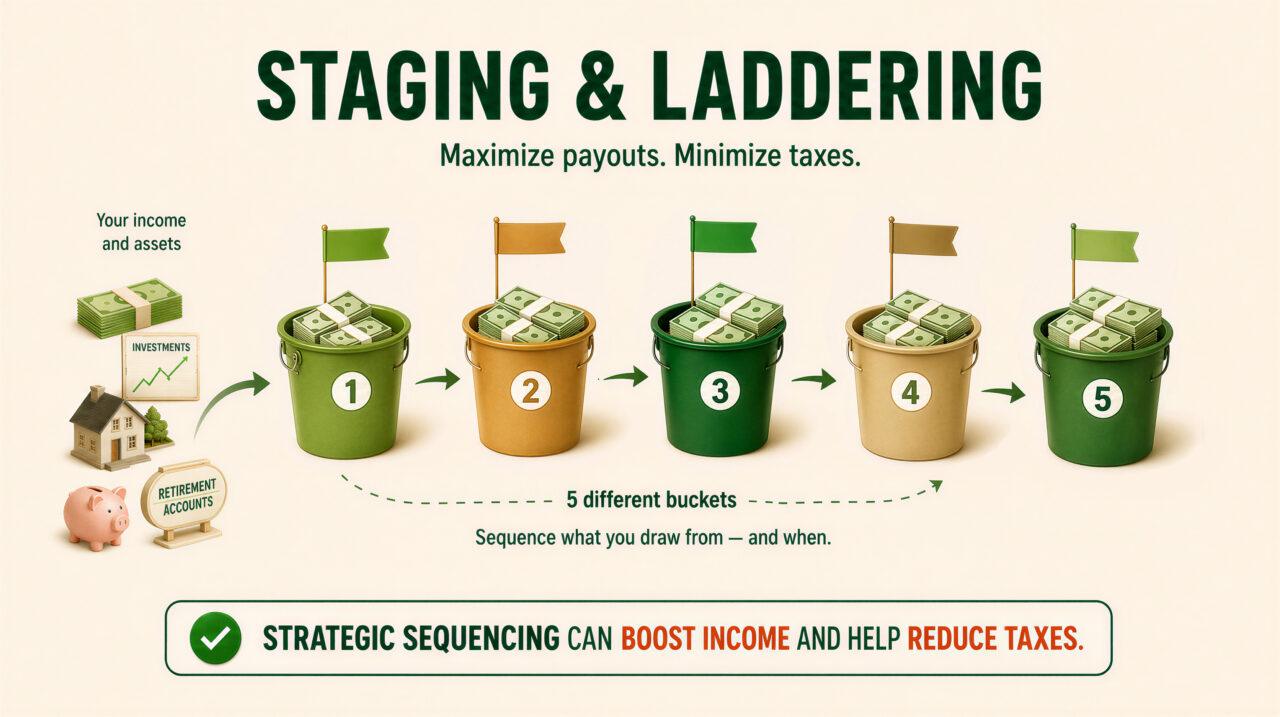
Staging separates your assets into five buckets, roughly in the order you’d want to draw from them to minimize taxes:
| Bucket | Source | Tax Treatment |
|---|---|---|
| 1 | Guaranteed paycheck (work, part-time job, Social Security) | Ordinary income |
| 2 | Bank/cash savings | Already taxed |
| 3 | Non-qualified brokerage accounts | Long-term capital gains, 0%-20% |
| 4 | Tax-free accounts (Roth IRA, cash-value life insurance) | Tax-free |
| 5 | Qualified accounts (401(k), 403(b), traditional IRA) | Ordinary income upon withdrawal |
As long as other buckets can cover your lifestyle, you can afford to let a Hybrid Pension keep deferring and growing toward a higher payout. (For how each bucket’s tax treatment fits into your overall bracket, see how your withdrawal tax bracket works.)
Laddering, the second half of the strategy, means splitting a Hybrid Pension into multiple pieces so each can be turned on at a different time. One ladder might start at an 8% payout while you defer the rest further out to reach 13%, then 15%. Some retirees defer every ladder as long as possible; others need one or two turned on right away. Every situation is different, which is exactly why this kind of planning is done individually rather than off a generic chart.
Why Most Advisors Don’t Walk You Through This
Here’s the thing. If you defer your payouts, naturally the next question you’ll ask is “How will I defer?” Then once you learn how you can defer, you’re going to ask about taxes. And it’s not just the taxes you pay now. It’s also the taxes you’ll pay in the future, too.
How about RMDs? Should you do Roth conversions? How about inflation? Then which bucket should you pull from first so you don’t overpay? How long will your other buckets last you?
All of this planning takes a lot of time. And whether an advisor sells you in a couple of hours or 10 hours we all make the same commission. Most advisors will not do this type of advanced planning. And if they do, they’ll typically charge a flat fee of $2500-$5000. Here at KCIIS, we developed a team that has your best interests at heart. We do all of this planning at no cost to you.
Frequently Asked Questions
What is the 10% to 15% rule with Hybrid Pensions?
It’s the idea that a properly structured guaranteed income Hybrid Pension can pay a contractual payout of 10% to 15% (or higher) depending on age and deferral period, compared to the 4% typically used for market-based withdrawal strategies. That difference can mean needing significantly less saved to reach the same retirement income.
Is a 10% to 15% payout the same as a 10% to 15% investment return?
No. A payout is not a return on investment. A payout rate is guaranteed in writing regardless of how much the underlying cash value grows. No institution can guarantee a 10% to 15% investment return for life besides an insurance company.
What is Staging & Laddering?
Staging and Laddering is a strategy for sequencing which accounts you draw from first in retirement, generally the least tax-efficient buckets last, while splitting a Hybrid Pension into multiple “ladders” that can be turned on at different times to capture higher deferred payout rates.
Do I need millions saved to retire comfortably?
Not necessarily. The amount needed depends on the withdrawal or income strategy you use. A market-only 4% rule approach requires far more savings than a strategy of guaranteed income. See our full breakdown of the traditional retirement number for the complete math.
Are all high guaranteed payout offers guaranteed?
Not always. Some advertised payouts aren’t actually contractually guaranteed once you read the fine print. That is because it depends on what type of income rider is attached to the policy. Read more about guaranteed and hypothetical hybrid pension income riders to understand the difference
See What Your Number Actually Looks Like
If you want to see what your specific numbers look like using a Staging & Laddering approach, we can walk through it with you at no cost.
We represent over 50 plans across all 50 states, and because we’re paid directly by the insurance carriers, the consultation costs you nothing.
Schedule a free, no-pressure consultation with our licensed advisory team at KCIIS today.



Contact Us Get in Touch
Have a question or feedback?
Fill out the form below, and we’ll respond promptly!
By providing your name and contact information, you are consenting to receive calls, text messages, and/or emails from a licensed insurance agent about Medicare Plans at the number provided. You agree that such calls and/or text messages may use an auto-dialer or robocall, even if you are on a government do-not-call registry. This agreement is not a condition of enrollment.
Not connected with or endorsed by the United States government or the federal Medicare program. This is a solicitation of insurance, and your response may generate communication from a licensed producer/agent.