
You worked hard your whole life. You saved. You did everything right.
But you still have this fear: What if I run out of money?
Here’s the problem. Most of us today don’t have what our parents once had, a pension. A guaranteed paycheck for life. Instead, we have our savings, our 401(k), and a spreadsheet full of projections.
So you start researching. The internet hits you with everything at once: the 4% rule, dividend stocks, bond ladders, CD ladders, bucket strategies, annuities, rental real estate. Every article tells you something different. Every advisor sells you something different. And the more you read, the more confused you get.
Here’s what almost everyone believes: that you need to keep growing your assets so you never run out of money. But retirement doesn’t have to be that complicated. The most successful retirees use a framework that combines multiple strategies, one that lets them retire wealthy and stop worrying about income altogether.
After 21 years helping families protect over $200 million in retirement income, we’ve found the retirees who feel the most confident aren’t the ones with the single best strategy. They’re the ones who understand which combination of strategies actually fits their life.
Why Does Retirement Feel So Overwhelming Without a Pension?
If you’ve been trying to figure this out on your own, you’re not alone.
You’ve probably spent hours, maybe weeks, going down the rabbit hole. The 4% rule. Dividend stocks. Bond ladders. Annuities. Every YouTube video, article, and podcast seems to say something different, because every “expert” has their own opinion, and most of them have something to sell you.
We worked with a client last year, a software engineer in his early 60s, who spent eight months researching retirement income on his own before he ever called us. Eight months. And at the end of it, he was no closer to a decision than the day he started.
That’s the real cost of going it alone: analysis paralysis, market stress, and confusion, stealing time you could have spent actually enjoying retirement.
The test: if you’ve read more than a handful of articles on retirement income and still don’t have a clear plan, the problem probably isn’t you. It’s that nobody’s shown you the actual structure underneath all the noise.
What Are the Three Real Paths for Retirement Income?
Here’s what almost everybody believes: that retirement income strategies are all just variations of investing. Pick the right stocks. Pick the right funds. Pick the right withdrawal rate. That’s the game.
But that’s not actually how this works. There are really only three paths for retirement income, and most retirees have no idea which one they’re shopping for.
- Market-based income — your money stays invested, and you draw it down over time
- Guaranteed income — a contractual paycheck that shows up no matter what the market does
- A blend of the two — a foundation of guaranteed income, with market-based growth layered on top
Think of it this way. Market-based income is like fishing for your dinner. Some days you eat well. Some days you go hungry. Guaranteed income is like getting a paycheck. It shows up every two weeks, like clockwork. Both can feed you. They just feel very different.
Here’s why this distinction matters so much: most retirees pick their strategies without knowing which path they’re on, and end up stacking two market-based strategies on top of each other with zero guaranteed income underneath. That’s how people who “did everything right” still walk into retirement scared to spend.
Once you see how every strategy falls into one of these three buckets, the question stops being “what’s the best strategy?” and starts being “what’s the right combination for me?“
What Are the Market-Based Income Strategies?
This is where the vast majority of retirement advice on the internet lives, and where most retirees default to, because if you spent your career investing in a 401(k), this is the world you already know.
| Strategy | How It Works | The Catch |
|---|---|---|
| The 4% Rule | Withdraw 4% of your portfolio per year, adjusting for inflation | Sequence-of-returns risk: a crash in your first 5 years can permanently damage the plan |
| Dividend Income | Live off quarterly dividend payments, leave principal untouched | Dividends aren't guaranteed. Hundreds of companies slashed or eliminated dividends in 2008 and again in 2020 |
| Interest Income | Park money in CDs, Treasuries, bonds, or money market funds | Inflation erodes real returns. From 2002 to 2012, interest rates sat near 0% to 1%, well below inflation |
The 4% rule is popular because it’s simple and keeps you in control of your money. If you’ve got a million dollars, you withdraw $40,000 a year. But if the market crashes early in your retirement, that million-dollar portfolio can drop to $700,000, and your $40,000 withdrawal starts eating into principal far faster than the math predicted.
Dividend income feels safer because the checks show up every quarter without touching your principal. But “feels guaranteed” and “is guaranteed” are different things. If you’re depending on that quarterly check to cover your mortgage and the company cuts its dividend in half, you have a real problem.
Interest income looks great when rates are high. The catch is inflation. Earning 4% interest while inflation runs at 3% means you’re really only making 1%, and that’s before accounting for years like 2002 to 2012, when rates barely moved while prices kept climbing.
What Are the Guaranteed Income Strategies?
The next framework is guaranteed income, and it includes strategies you’re probably familiar with and at least one you may have never heard of.
The advantage across all of them: you don’t manage anything. You don’t watch the market. You don’t worry about sequence-of-returns risk or whether a dividend gets cut. A check just shows up, every month, for life.
| Strategy | The Advantage | The Limitation |
|---|---|---|
| Social Security | Guaranteed for life, adjusts for inflation, spousal protection built in | Most people leave money on the table by claiming too early or not coordinating with a spouse |
| Traditional Pensions | A monthly check for life, no matter what the market does | Nearly extinct outside of teachers and government workers |
| Traditional Annuities | Some provide guaranteed lifetime income without locking up your money | SPIA and DIA annuities lock up your money for life; Variable and RILA annuities often carry hidden fees |
| Hybrid Pensions | Lifetime contractual income, without locking up your principal or hidden fees | Cash value growth is modest, closer to a CD or bond than the stock market |
Social Security is the foundation for almost every retiree in America. It’s guaranteed for life, it adjusts for inflation every year, and if you’re married, your spouse keeps getting paid after you’re gone. That’s three of the biggest retirement risks, outliving your money, inflation, and spousal protection, solved by one program. The problem is that most people don’t run the numbers on whether to claim at 62, 67, or 70, and the difference between claiming wrong and claiming right can be hundreds of thousands of dollars over a lifetime.
Traditional pensions used to do all the heavy lifting for American retirees. Workers with little in savings could retire worry-free because a monthly check showed up no matter what the market did. Today, they’re hard to find outside a handful of professions, which is exactly the gap we’re talking about.
Traditional annuities have the worst reputation of the bunch, and honestly, some of that reputation is earned. Almost everybody believes annuities lock up your money, come loaded with hidden fees, and get pushed by a slick salesperson. That’s true of some annuities. SPIA and DIA annuities do lock up your money for life. Variable and RILA annuities often carry the hidden fees people are afraid of. But not all annuities work that way.
How Does a Hybrid Pension Actually Work?
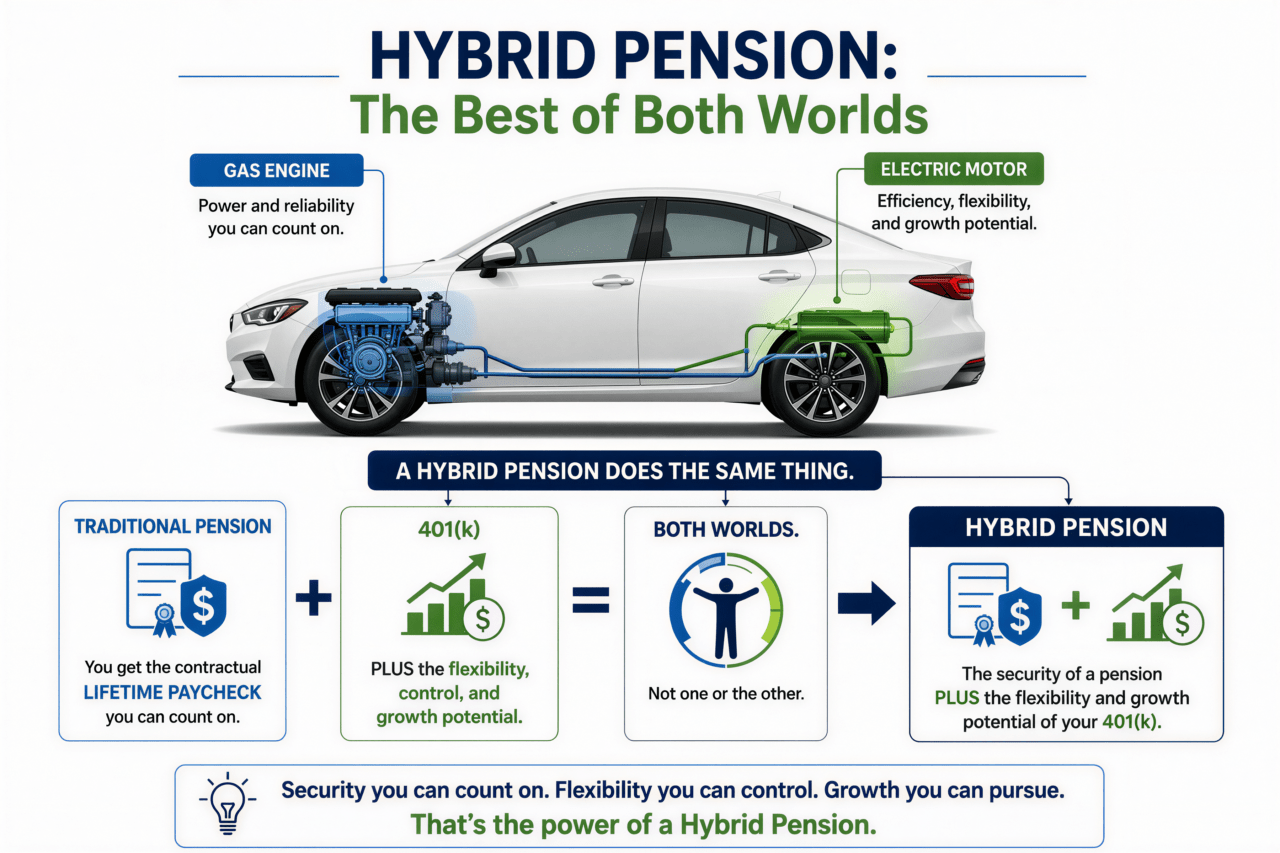
A Hybrid Pension provides lifetime contractual income similar to a private pension or traditional income annuity, but without locking up your money. You keep control of your principal, you don’t carry the hidden fees that come with Variable or RILA annuities, and if you pass away, whatever’s left goes to your family instead of the insurance company.
Guaranteed lifetime income rates vary based on your age and how many years you defer, and they increase the longer you wait. What most people don’t realize is how quickly the payout can grow with deferral, so the exact rate you’d qualify for depends on your specific situation and the carrier.
The tradeoff is cash growth. While the income can outpace market-based withdrawal strategies, the cash value itself isn’t designed to beat the market, it’s built more like a CD or bond. Think of it like buying a sports car. You’re buying it for the power, not the gas mileage. Retirees use Hybrid Pensions to accelerate guaranteed income in a way market-based strategies alone can’t sustain.
Most people have never heard of this option because it doesn’t generate ongoing management fees the way market investments do. We’re paid directly by the insurance companies, the same way a car insurance agent is paid, so you pay nothing out of pocket, and our commission is a one-time payment. Advisors who charge an annual fee for life have less incentive to move any of your money out of the market. (Our full breakdown of how Hybrid Pension payouts work goes deeper on the mechanics.)
Every strategy in this framework shares one thing the market-based strategies don’t: guaranteed income for life, no matter what the market does. That’s the kind of income that takes the fear of running out off the table entirely.
What Does a Blended Framework Look Like in Real Numbers?
Here’s where it gets interesting: almost no successful retiree uses only one framework. They combine them.
A blended approach can’t grow your money as high as the market theoretically could, and it can’t guarantee as much as going all-in on guaranteed income. But it gives you something neither extreme can: a steady paycheck and room to grow.
The foundation is guaranteed income that isn’t market-dependent, so you can spend without guilt, just like a real paycheck from work. Then market-based growth gets layered on top for discretionary spending, more like a bonus. The part most people miss is that the guaranteed income doesn’t hold your cash back from market opportunities, it frees you to buy and hold. When a paycheck is already covering what you need, you stop being forced to sell at the bottom. You can ride out the dips and let compound growth do its job.
Most retirees who skip the guaranteed income piece end up spending their whole retirement watching the market. Every dip becomes a panic, because they know that if the market drops at the wrong time, they’re the ones eating the loss. That’s not retirement. That’s just being a portfolio manager with grey hair.
A real example. Say you’ve got $1.5 million saved, a common number for the people we work with. Here’s one way to structure it:
| Strategy | Allocation | Annual Income |
|---|---|---|
| Hybrid Pension | $900,000 | $90,000 (illustrative, based on a 10% payout rate) |
| Market (4% Rule) | $600,000 | $24,000 |
| Social Security | — | $36,000 |
| Total | $1.5 million | $150,000 for life |
Compare that to relying on the 4% rule alone: $1.5 million would generate roughly $60,000, plus $36,000 in Social Security, for a total of $96,000.
What makes this blend powerful is that the Hybrid Pension and Social Security together already cover $126,000 of guaranteed income. That means the remaining $600,000 in the market doesn’t have to perform. It doesn’t have to cooperate with the latest headline, because it’s simply growth on top of a floor you don’t need to survive. Instead of panic-selling, you can let it grow, because you don’t need it to live.
Other blends we see often:
- Social Security plus a dividend portfolio — Social Security covers the basics, the dividend portfolio funds travel and extras
- A pension plus a bond ladder — for the few who still have a traditional pension, the pension does the heavy lifting and the bond ladder smooths the bumps
- Social Security, rental income, and a Hybrid Pension — for retirees who already own investment property, this adds a third leg: foundation, cash flow, and a gap-filler
Think of these blends like a three-legged stool. One leg is unstable. Two legs are wobbly. Three legs is solid ground, a retirement that holds up no matter what the market, the economy, or a tenant decides to do next year.
Your job isn’t to pick the one perfect strategy. It’s to figure out which combination fits your life, your spending, and your tolerance for risk.
What Are the Six Risks Every Retiree Faces?
Before you build your framework, you need to know which risks you’re actually trying to solve for.
| Risk | What It Means |
|---|---|
| Longevity | Outliving your money |
| Sequence of returns | A market crash in your first few years of retirement |
| Inflation | The slow erosion that can cut your dollar's value in half over 30 years |
| Recession | One bad recession can set you back a decade |
| Real estate | A lawsuit or vacancy can wipe out years of rental profit |
| Surviving spouse | Two sources of guaranteed income become one |
No single strategy eliminates all six. But a blended framework gets close. The guaranteed layer handles longevity, sequence of returns, recession, and real estate risk. Market growth and layered guaranteed income help address inflation and protect a surviving spouse. That’s the whole point of blending: each piece covers what the others can’t.
The cost of missing even one of these risks can be a decade of compromise, a spouse forced back to work, or the retirement you planned for disappearing because of a risk you never saw coming.
The smart play isn’t picking the single best strategy. It’s combining strategies so each one covers the gaps the others leave open. That’s how you build a retirement plan you can actually trust.
Frequently Asked Questions
What are the three types of retirement income strategies?
Market-based income (your money stays invested and you draw it down), guaranteed income (a contractual paycheck that shows up regardless of the market), and a blend of the two. Most successful retirees use a blend rather than committing entirely to one path.
What is a Hybrid Pension?
A Hybrid Pension is a type of fixed indexed annuity that provides guaranteed lifetime income without locking up your principal. Unlike SPIA or DIA annuities, you keep control of your cash value, and any remaining balance passes to your beneficiaries. Payout rates depend on your age, deferral period, and carrier.
Is the 4% rule still a safe retirement strategy?
The 4% rule can work, but it carries sequence-of-returns risk. A market downturn in your first several years of retirement can permanently reduce how long your portfolio lasts, since you’re withdrawing from a smaller balance while it’s trying to recover.
How much do I need saved to retire with $150,000 a year in income?
It depends heavily on which framework you use. A pure 4% rule approach requires far more saved than a blended approach that layers guaranteed income underneath market growth. (See our full example above for how $1.5 million can be structured to generate $150,000 versus $96,000, depending on the framework.)
Ready to Build Your Own Framework?
Every strategy in this article has a place. The question isn’t which one is the best. It’s which combination actually fits your life, your spending, and how much risk you’re comfortable carrying.
If you’ve got a 401(k), savings, or any retirement accounts and want to see what your numbers could look like with a blended framework, including a Hybrid Pension, we can walk you through it. We represent over 50 plans across all 50 states, and because we’re paid directly by the insurance carriers, the consultation costs you nothing.
Schedule a free, no-pressure consultation with our licensed advisory team at KCIIS today.
I am text block. Click edit button to change this text. Lorem ipsum dolor sit amet, consectetur adipiscing elit. Ut elit tellus, luctus nec ullamcorper mattis, pulvinar dapibus leo.



Contact Us Get in Touch
Have a question or feedback?
Fill out the form below, and we’ll respond promptly!

By providing your name and contact information, you are consenting to receive calls, text messages, and/or emails from a licensed insurance agent about Medicare Plans at the number provided. You agree that such calls and/or text messages may use an auto-dialer or robocall, even if you are on a government do-not-call registry. This agreement is not a condition of enrollment.
Not connected with or endorsed by the United States government or the federal Medicare program. This is a solicitation of insurance, and your response may generate communication from a licensed producer/agent.