
Have you ever asked yourself, “Why am I still working?“
Most people assume the answer is that they haven’t hit their magic number yet. Maybe it’s one million, and then you can finally retire. But here’s the problem: that number isn’t the finish line you think it is. Why? Because in retirement, your savings have to fund everything, your necessities and your lifestyle. And most people don’t realize how much time they’ll actually have on their hands. Twelve months of free time a year, instead of the usual two weeks of vacation. More travel, more grandkids, more enjoying life.
After 21 years helping people protect over $200 million in retirement income, we’ve found the people who retire earliest aren’t the ones with the most money. They’re the ones who can say yes to five specific questions.
Here is the gap we see again and again: most people have a strong offensive strategy to grow their money, but no defense. As the saying goes, offense wins games, defense wins championships. These five questions are your defensive game plan.
Question 1: Do I Have Enough for My Lifestyle, Not Just My Expenses?
Most people ask, “Do I have enough for my basic expenses?” That is the wrong question.
The real question is: Do I have enough to cover my retirement lifestyle? Covering expenses keeps the lights on. Covering your lifestyle is what makes retirement worth it, and the retirees who ignore this are the ones who end up back at work or draining their accounts far faster than planned.
Here is what makes retirement different. For the first time in your life, you have time and money at the same time:
- At 30, you had time but no money.
- At 50, you had money but no time.
- In retirement, you finally have both.
And that costs more than people expect. A single vacation averages around $5,000, and most retirees want four or five a year. That alone is $20,000 to $25,000 a year, just on travel.
The Slow-Go Myth
You have probably heard retirement comes in three phases: go-go, slow-go, no-go. Most people assume the slow-go years cost less because you naturally do less. That is only half true.
Slow-go years cost less only because retirees don’t want to start spending on the things that would make life easier. Instead of touring a new city on foot, you could hire transportation. Instead of cleaning around the house yourself, you hire help to come once a week. Your spending does not have to drop, you just reallocate it toward accommodations and convenience.
The Hidden Cost: Taxes
When you were working, your salary covered your lifestyle and your taxes. Now your savings have to cover both. What you get to spend is not what you withdraw.
Want to spend $80,000 a year from your IRA? You may need to withdraw closer to $100,000 to cover federal and state taxes, a 20% to 30% bigger bite than your retirement calculator told you. (See our guides to the 2026 tax brackets and the different types of retirement accounts for how withdrawal taxes actually work.)
The test for Question 1: Pull your last twelve months of actual spending, not your budget, your statements. Add what you would like to spend in retirement (vacations, hobbies, bucket list). Then add roughly 20% for taxes. That is your real retirement number, and it is the number your plan has to cover.
If this hits home, our full breakdown of why so many retirees feel they can’t spend freely goes deeper on the lifestyle gap.
Question 2: Can I Bridge the Gap to Social Security Without Depending on the Market?
When you retire, you pull from your portfolio until Social Security kicks in. Depending on your strategy, that gap could be a couple of years or more than ten if you wait until 70.
So the question is whether you can cover 100% of your lifestyle during that gap, without betting on the market.
The risk of market downturns has a name: sequence-of-returns risk. A crash in your first few years of retirement, while you are withdrawing to fund your life, can do permanent damage. A good long-term average won’t be able to help.
A real life example: In 2007, a 65-year-old dentist was ready to retire, he could not stop talking about the trips he would finally take. Then 2008 hit. Rather than retire and sell at the bottom, he worked five more years waiting for his portfolio to recover. And it did. But six years of his dream retirement were gone. (We cover this dynamic in depth in why the 4% rule leaves retirees exposed.)
The test for Question 2: Can you bridge the entire gap to Social Security without depending on market returns, backed by some secure income, a pension, a hybrid pension, cash reserves, part-time work, or a mix? Something that pays you whether the market is up or down.
Question 3: Can I Cover All Three Stages of Healthcare?
This is the question people understate the most. If you are retiring before 65, you probably ask, “Can I cover healthcare before Medicare?” But healthcare in retirement actually comes in three stages, and most people only plan for the first two.
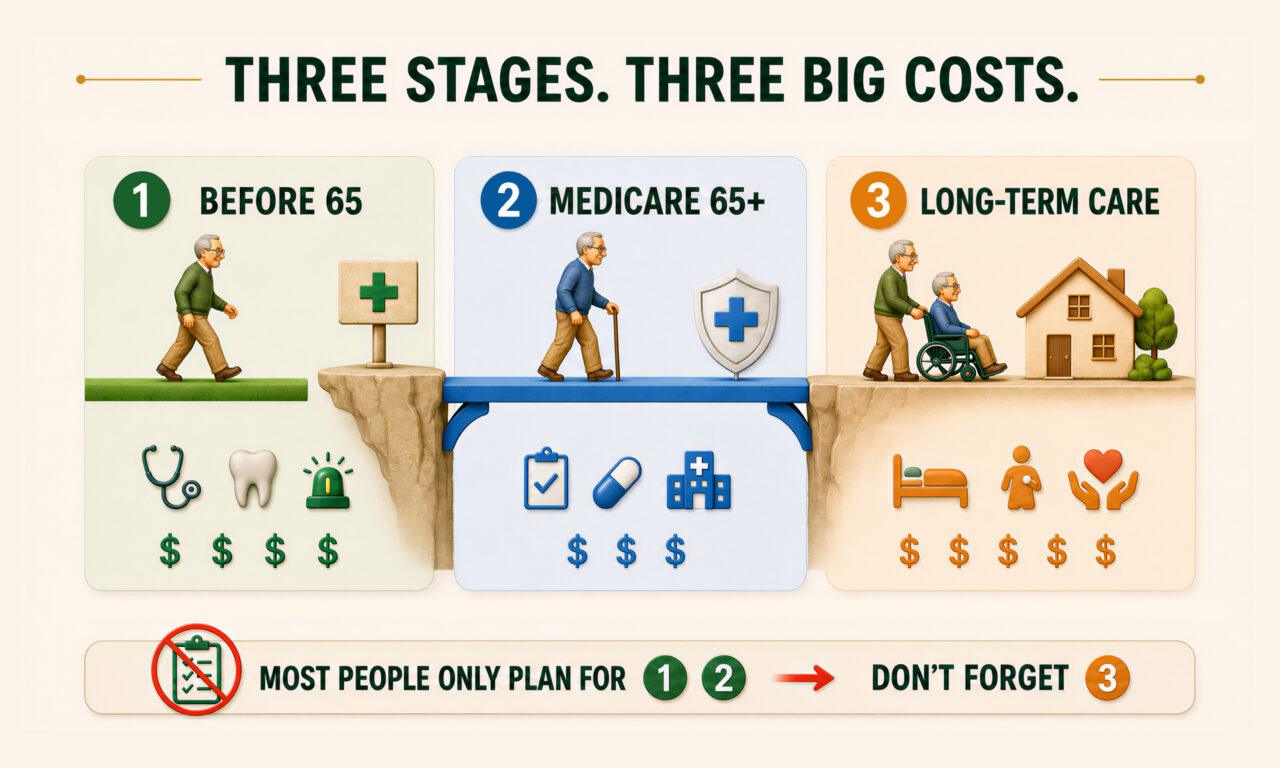
| Stage | When | Typical Cost |
|---|---|---|
| Stage 1: Pre-65 | Before Medicare eligibility | $12,000–$30,000/year per person |
| Stage 2: Medicare | Age 65 and beyond | $2,400–$5,500/year, plus IRMAA surcharges for high earners |
| Stage 3: Long-term care | Whenever care is needed | $36,000–$144,000+/year for home care alone |
Stage 1 catches early retirees off guard. Retire at 60 and you need to cover five years of your own health insurance, a $60,000 to $150,000 gap for one person. Double it for a couple.
The Long-Term Care Trap
Stage 3 is the one that scares us most, because the common wisdom is wrong. Most people think long-term care means a nursing home, two to four years, only a 15% chance you will ever need it.
But that statistic is only about nursing homes. It leaves out what actually happens first: home care, which can last 5 to 10 years before a nursing home ever enters the picture. Over 70% of us will use some form of long-term care.
[IMAGE: The 8-Year Reality LTC math infographic]
Kai’s mother cared for his grandmother for eight years of home care before a nursing home was ever needed. Here is what that costs today:
- Part-time home care: about $3,000/month
- Full-time home care: about $6,000/month
- Around-the-clock care: over $12,000/month
Do the math. Just $6,000 a month for eight years is nearly $600,000, and that is before assisted living or a nursing home, which can run another $5,000 to $15,000 a month. If your plan only addresses the first two stages, you have prepared for the cheapest part of retirement healthcare. (Our guide to long-term care breaks down your options.)
The test for Question 3: Does your plan have a real answer for all three stages, especially a long-term care event lasting five years or more? Not a “we’re healthy, we’ll figure it out” plan. An actual plan.
The good news: covering it does not necessarily mean buying long-term care insurance. Some people self-insure. Others rely on a high guaranteed income floor (a pension or hybrid pension on top of Social Security). Some blend LTC insurance with self-insuring. Any of these can earn you a yes.
Question 4: Is My Strategy Bulletproof Against All Six Retirement Risks?
Most people think “bulletproof” means having enough, a million, two million, five million. Hit the number and you are safe.
It is not that simple. A bulletproof plan has little to do with how much you have. It is about whether your income stays consistent even during terrible markets. A couple with two pensions can be more resilient in a market downturn than a couple with $2 million in the market.
No single framework fits everyone, it depends on your lifestyle, risk tolerance, and savings. But the strongest plans share one trait: a solid guaranteed income floor that can withstand all six major retirement risks.
| Risk | What It Means |
|---|---|
| Longevity | Outliving your money |
| Sequence of returns | A market crash in your first few years |
| Inflation | Today's income is worth half in 20 years |
| Recession | One bad recession can set you back a decade |
| Real estate | A lawsuit or vacancy wipes out years of profit |
| Surviving spouse | Two guaranteed incomes become one |
The test for Question 4: Instead of asking “Do I have the best investment framework?”, ask “Will my framework hold up against all six of these risks?”
For a deeper look at building that guaranteed income floor, see do you really need an annuity?
A Quick Word on Frameworks
We talk about three main retirement frameworks:
- Market + Social Security — relies on the 4% rule, which means you need the most saved (a $100,000 lifestyle can require around $1.75 million).
- Guaranteed Income + Social Security — needs far less, because structured properly, a hybrid pension can pay 10% to 20% for life.
- The blend — guaranteed income, Social Security, and market growth together.
The framework you choose can dramatically change how much you actually need. We ran three people with $3 million, $2 million, and $1.5 million who all reached the same $150,000 goal, even the one with half the assets. Our article on why the $1.5 million rule is broken walks through that math.
One clarification, since “guaranteed income” makes people nervous: we are not talking about SPIA or DIA annuities that lock up your money for life. We mean a Hybrid Pension, which lets your cash grow, gives your money back if you change your mind, passes the remainder to your beneficiaries, and pays you for life if you live long. You can fund one with IRA or non-IRA money.
Question 5: Does the Plan Still Work If One of Us Is Gone?
Most couples think they have solved this. If something happens to one spouse, the other gets the life insurance payout. Problem solved.
But here is what most people miss. The real risk is not the chance of dying. It is leaving your spouse with money they do not know how to manage, or an income gap they cannot fill.
In most couples, one person handles the money, the investments, the accounts, the plan. When that person goes first, the survivor is grieving and suddenly responsible for investments they have never touched. In fact, over 90% of the couples who call us say a major reason they want guaranteed income is peace of mind for their spouse.
Run the Life Insurance Math
Most agents will just tell you to buy more life insurance. It has its place, but run the numbers:
- Policy: $500,000
- Spouse’s spending: $80,000/year
- Over 20 years, that is $1.6 million needed, before inflation
- That $500,000 policy is gone in about six years
And buying life insurance in your 50s and 60s gets expensive fast, if you can even qualify. It also raises your yearly costs while you are alive. The better answer is guaranteed income that keeps paying your spouse every month, for the rest of their life.
A real example: A widow came to us who once had over $2 million, all in the market, with her husband managing everything. By the time he passed, years of home care, assisted living, and nursing care had consumed $1.5 million. She was left with $500,000, no guaranteed income, and the fear of running out. A framework with guaranteed income for the survivor could have covered most or all of that. By the time she reached us, all we could do was work with what was left.
The test for Question 5: If you were gone tomorrow, could your spouse continue their lifestyle without ever running out of money, and live a worry-free retirement?
So, How Many Can You Say Yes To?
If you can say yes to all five, it may be time to tell your boss you are ready.
If you cannot, that is okay, the point was never to convince you to retire tomorrow. It was to help you find what is missing. Most people have a strong offensive strategy for growing their money. What they lack is defense.
That is where we come in. We are not here to replace your financial advisor, keep them for offensive market growth. We are your defensive coach, building a complete framework that combines your market strategies with guaranteed income. We are independent, represent over 50 plans across all 50 states, and are paid directly by the insurance carriers, the way your car insurance agent is, so our consultations cost you nothing.
Frequently Asked Questions
What are the five questions to ask before retiring?
They are: (1) Do I have enough for my lifestyle, not just expenses? (2) Can I bridge the gap to Social Security without depending on the market? (3) Can I cover all three stages of healthcare, including long-term care? (4) Is my strategy bulletproof against all six retirement risks? (5) Does the plan still work if one spouse is gone? If you can answer yes to all five, you are likely ready to retire.
How much do I actually need to retire?
It depends far more on your framework than most people think. Using the traditional 4% rule, a $100,000 lifestyle can require around $1.75 million. Using a guaranteed-income framework, the same lifestyle can require significantly less, because a hybrid pension can pay a much higher contractual rate. Your real number also has to include taxes and healthcare, which most calculators leave out.
What are the three stages of retirement healthcare?
Stage 1 is pre-65 coverage before Medicare ($12,000–$30,000/year per person). Stage 2 is Medicare from 65 on ($2,400–$5,500/year plus possible IRMAA surcharges). Stage 3 is long-term care, which most people underestimate, home care alone can run $36,000 to $144,000+ per year and often lasts years before a nursing home is needed.
Do I need long-term care insurance to be covered?
Not necessarily. Some people self-insure, some rely on a high guaranteed income floor from a pension or hybrid pension, and some blend LTC insurance with self-insuring. What matters is having a real plan for a care event lasting five years or more.
Is a hybrid pension the same as a traditional annuity?
No. Traditional SPIA and DIA annuities lock up your money for life, and we generally do not recommend them. A hybrid pension keeps your cash accessible, lets it grow, returns the balance to your beneficiaries, and still pays you for life if you live long.
Ready to Build Your Defense?
If you could not say yes to all five questions, that is exactly what we help fix.
Schedule a free, no-pressure consultation with our licensed advisory team at KCIIS today. We will look at all five questions with you and show you what a bulletproof retirement actually looks like.



Contact Us Get in Touch
Have a question or feedback?
Fill out the form below, and we’ll respond promptly!
By providing your name and contact information, you are consenting to receive calls, text messages, and/or emails from a licensed insurance agent about Medicare Plans at the number provided. You agree that such calls and/or text messages may use an auto-dialer or robocall, even if you are on a government do-not-call registry. This agreement is not a condition of enrollment.
Not connected with or endorsed by the United States government or the federal Medicare program. This is a solicitation of insurance, and your response may generate communication from a licensed producer/agent.